Product Usage: This PRODUCT IS INTENDED AS A RESEARCH CHEMICAL ONLY. This designation allows the use of research chemicals strictly for in vitro testing and laboratory experimentation only. All product information available on this website is for educational purposes only. Bodily introduction of any kind into humans or animals is strictly forbidden by law. This product should only be handled by licensed, qualified professionals. This product is not a drug, food, or cosmetic and may not be misbranded, misused or mislabeled as a drug, food or cosmetic.

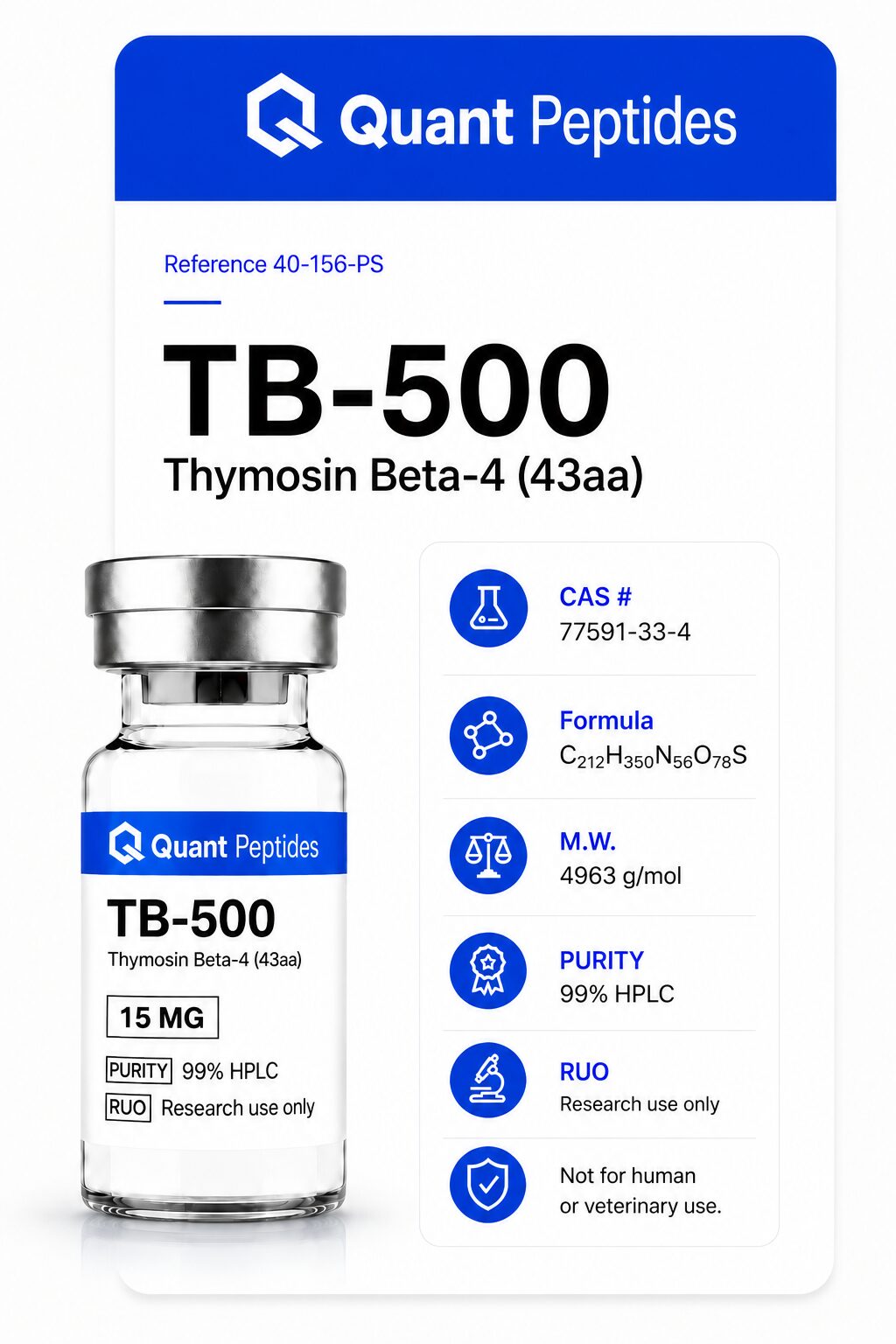
TB-500 (Thymosin Beta-4) 15mg (43aa)

Thymosin Beta-4, commonly referred to as TB-500, is a synthetic peptide sequence composed of 43 amino acids. It is modeled after a naturally occurring peptide found in many human and animal cells and has been widely studied for its potential role in tissue protection, repair, regeneration, and remodeling following injury or cellular stress.

In animal research models, Thymosin Beta-4 has been shown to support blood vessel formation, influence wound-healing activity, regulate inflammatory response, and help protect tissues from oxidative stress. These effects have been studied in several areas, including cardiac tissue, skeletal muscle, skin, and the central nervous system.

Because of its involvement in cellular migration, angiogenesis, inflammation regulation, and tissue-repair pathways, TB-500 remains an active area of interest in recovery, regenerative medicine, tissue health, and aging-related research.

$129.00

Buy 5 and save 5%
$122.55 each
Buy 10 and save 8%
$118.68 each

TB-500 Research

Thymosin Beta-4, commonly referred to as TB-500, is a synthetic version of a naturally occurring 43-amino-acid peptide found in many human and animal cells. It has been studied for its potential role in tissue repair, cellular migration, inflammation regulation, and recovery following injury.

Research has explored TB-500 in cardiac repair models, including studies related to myocardial injury and myocardial infarction. Findings suggest that TB-500 may help reduce myocardial cell death, support new blood vessel formation, and activate repair pathways involved in heart tissue recovery. Earlier animal studies also reported effects related to cardiomyocyte migration, cell survival, and repair of damaged cardiac tissue. [1] [2]

TB-500 has also been studied in respiratory research, particularly in relation to mucus transport. In cystic fibrosis models, filamentous actin, also known as F-actin, can contribute to thicker sputum and impaired mucus clearance. When TB-500 was studied in combination with dornase alfa, researchers observed dose- and time-dependent improvements in sputum properties, along with improved mucociliary transport and cough-assisted mucus clearance. [3]

Additional research has examined TB-500 in skeletal muscle repair. Studies suggest that TB-500 may influence myoblasts and myocytes, which are cells involved in muscle formation, repair, and regeneration. Research also indicates that TB-500 activity may increase following muscle injury, supporting local repair signaling, inflammation modulation, and migration of myoblasts to the injured area. These mechanisms may contribute to skeletal muscle fiber regeneration after injury. [4]

TB-500 (Thymosin Beta-4) 2mg

TB-500 Structure Peptide

Sequence: Ac-Ser-Asp-Lys-Pro-Asp-Met-Ala-Glu-Ile-Glu-Lys-Phe-Asp-Lys-Ser-Lys-Leu-Lys-Lys-Thr-Glu-Thr-Gln-Glu-Lys-Asn-Pro-Leu-Pro-Ser-Lys-Glu-Thr-Ile-Glu-Gln-Glu-Lys-Gln-Ala-Gly-Glu-Ser 
Molecular formula: C212H350N56O78S 
Molar Mass: 4963.4408
CAS number: 77591-33-4 
PubChem: CID 16132341 
Synonyms: Thymosin Beta 4

TB-500 Research Overview

TB-500 has been studied across a wide range of research areas involving tissue repair, inflammation, immune response, and recovery-related biological processes.

In a 2009 study using 0.01% TB-500 eye drops, researchers observed faster healing after eye surgery in diabetic patients. This group was especially important to study because diabetes is commonly associated with delayed wound healing and a higher risk of eye-related complications, including diabetic retinopathy. The study reported no serious side effects, although headache, dizziness, and insomnia occurred more often in the TB-500 group than in the control group. Researchers also found that diabetic retinopathic corneas expressed lower levels of naturally occurring TB-500 compared with normal corneas, suggesting that reduced endogenous TB-500 may contribute to slower healing after eye injury or surgery. TB-500 eye drops have also been studied in chronic dry eye, where participants showed symptom improvement with rare and minimal complications. [5] [6]

TB-500 has also been evaluated in research involving chronic hepatitis B combined with nonalcoholic fatty liver disease. While TB-500 levels did not appear to correlate with hepatitis B viral levels or liver markers such as AST, ALT, or triglycerides, researchers observed an inverse relationship with inflammation and fibrosis scores. In simpler terms, lower TB-500 levels were associated with more severe inflammation and fibrosis. These findings suggest that TB-500 may have relevance in certain liver-related research models. [7]

A 2010 human safety and tolerance study evaluated intravenous TB-500 doses ranging from 42 mg to 1260 mg daily for 14 days. The study reported no treatment-related adverse effects and no evidence of dose-related toxicity within the range studied. [8]

TB-500 has also been studied in immune-response research. In one study, healthy volunteers were intentionally exposed to rhinovirus, a common cold virus, while blood markers were monitored over five days. By the fifth day, serum cortisol, thymosin alpha-1, and TB-500 levels increased. Several immune cell populations also increased, including T-lymphocytes, cytotoxic/suppressor cells, and natural killer cells. These findings suggest a possible relationship between thymosin-related peptides and the body’s immune response following respiratory virus exposure. [9]

Kidney disease research has also explored TB-500. In mouse studies, TB-500 levels did not appear to affect healthy kidney tissue. However, in mice with existing kidney disease, lower TB-500 levels were associated with worsening disease progression. Researchers suggested that naturally occurring TB-500 may help protect kidney tissue and slow disease-related damage in certain models. [10]

TB-500 has been widely examined in wound-healing research. Studies involving both animal and human subjects have explored its role in burns, diabetic ulcers, pressure ulcers, stasis ulcers, epidermolysis-related wounds, wounds in elderly subjects, and other tissue injuries. Research suggests that TB-500 may support wound healing by promoting angiogenesis, helping regulate inflammation, and increasing platelet activity at wound sites. [11]

A 2015 meta-analysis reviewed broader TB-500 research and highlighted its potential involvement in tissue repair and regeneration across multiple biological systems. Areas of interest included cardiac repair after myocardial injury, neurological recovery after stroke or trauma, kidney and liver disease models, spinal cord repair, bone and ligament injury, aging-related decline, and viral-response pathways. [12]

Bone-healing studies have also investigated TB-500. In mouse fracture models, TB-500-treated subjects developed stronger healed fractures compared with untreated controls. Treated mice showed a 41% increase in peak force to failure, and healed fractures were 25% stiffer than those in untreated mice. Imaging performed 21 days after fracture showed improvement of up to 26% compared with untreated subjects. Researchers also observed smaller callus formation and increased trabecular bone area, suggesting faster and more organized bone repair. [13]

TB-500 has also been studied in spinal cord injury models. In a 2014 rat study, TB-500 was administered either 30 minutes, 3 days, or 5 days after mild compression-induced spinal cord injury. Treated rats showed notable improvement in locomotor and behavioral assessments. Researchers also observed reduced inflammatory cytokines, smaller scar formation, and myelin protein levels that were 57.8% higher than the control group. These findings suggest that TB-500 remains an area of interest in spinal cord injury and repair-related research. [14]

In traumatic brain injury research, TB-500 has been studied in rat models. While no animal model perfectly replicates human head injury, rats are commonly used because their neurological and behavioral responses are well characterized. Research suggests that TB-500 may have both neuroprotective and neurorestorative effects, including support for blood vessel formation, new brain cell development, and new neural connections following injury. [15]

TB-500 has also been investigated in models of multiple sclerosis. In a 2016 study by Zhang et al., TB-500 administration increased the generation of new oligodendrocytes and reduced axonal damage compared with controls. The newly generated oligodendrocytes contributed to remyelination of axons, which was associated with functional improvement in the study model. [16]


References

1

Ann N Y Acad Sci. 2010 Apr;1194:87-96.  Thymosin beta4 and cardiac repair. Shrivastava S1, Srivastava D, Olson EN, DiMaio JM, Bock-Marquette I.

2

Nature. 2004 Nov 25;432(7016):466-72. Thymosin beta4 activates integrin-linked kinase and promotes cardiac cell migration, survival and cardiac repair.  Bock-Marquette I1, Saxena A, White MD, Dimaio JM, Srivastava D.

3

Chest. 2006 Nov;130(5):1433-40.  Thymosin beta4 sequesters actin in cystic fibrosis sputum and decreases sputum cohesivity in vitro. Rubin BK1, Kater AP, Goldstein AL.

4

J Biochem. 2011 Jan;149(1):43-8. doi: 10.1093/jb/mvq115. Epub 2010 Sep 29. Muscle injury-induced thymosin β4 acts as a chemoattractant for myoblasts. Tokura Y1, Nakayama Y, Fukada S, Nara N, Yamamoto H, Matsuda R, Hara T.

5

https://clinicaltrials.gov/show/NCT00598871

6

Ann N Y Acad Sci. 2010 Apr;1194:199-206. doi: 10.1111/j.1749-6632.2010.05471.x. Treatment of chronic nonhealing neurotrophic corneal epithelial defects with thymosin beta4.  Dunn SP1, Heidemann DG, Chow CY, Crockford D, Turjman N, Angel J, Allan CB, Sosne G.

7

Medicine (Baltimore).2016 Dec;95(52):e5763. doi: 10.1097/MD.0000000000005763. The expression of thymosin β4 in chronic hepatitis B combined nonalcoholic fatty liver disease.  Liang J1, Cai W, Han T, Jing L, Ma Z, Gao Y.

8

Ann N Y Acad Sci. 2010 Apr;1194:223-9. doi: 10.1111/j.1749-6632.2010.05474.x. A randomized, placebo-controlled, single and multiple dose study of intravenous thymosin beta4 in healthy volunteers.  Ruff D1, Crockford D, Girardi G, Zhang Y.

9

Lymphokine Res. 1989 Winter;8(4):383-91.  Modulation of thymosin alpha 1 and thymosin beta 4 levels and peripheral blood mononuclear cell subsets during experimental rhinovirus colds.  Hsia J1, Sztein MB, Naylor PH, Simon GL, Goldstein AL, Hayden FG.

10

Kidney Int. 2016 Nov;90(5):1056-1070. doi: 10.1016/j.kint.2016.06.032. Epub 2016 Aug 26.  Loss of endogenous thymosin β4 accelerates glomerular disease. Vasilopoulou E1, Kolatsi-Joannou M1, Lindenmeyer MT2, White KE3, Robson MG4, Cohen CD2, Sebire NJ1, Riley PR5, Winyard PJ1, Long DA6.

11

Vitam Horm. 2016;102:251-75. doi: 10.1016/bs.vh.2016.04.005. Epub 2016 May 24. Thymosin β4 Promotes Dermal Healing.  Kleinman HK1, Sosne G2.

12

Expert Opin Biol Ther. 2015;15 Suppl 1:S139-45.doi:10.1517/14712598.2015. 1011617.  Epub 2015 Jun 22. Advances in the basic and clinical applications of thymosin β4. Goldstein AL1, Kleinman HK.

13

J Orthop Res. 2014 Oct;32(10):1277-82. doi: 10.1002/jor.22686. Epub 2014 Jul 8. Thymosin β4 administration enhances fracture healing in mice. Brady RD1, Grills BL, Schuijers JA, Ward AR, Tonkin BA, Walsh NC, McDonald SJ.

14

Neuropharmacology. 2014 Oct;85:408-16. doi: 10.1016/j.neuropharm.2014.06.004. Epub 2014 Jun 14.  Beneficial effects of thymosin β4 on spinal cord injury in the rat. Cheng P1, Kuang F1, Zhang H1, Ju G2, Wang J3.

15

Ann N Y Acad Sci. 2012 Oct;1270:51-8. doi: 10.1111/j.1749-6632.2012.06683.x. Neuroprotective and neurorestorative effects of thymosin β4 treatment following experimental traumatic brain injury.  Xiong Y1, Mahmood A, Meng Y, Zhang Y, Zhang ZG, Morris DC, Chopp M.

16

Neurobiol Dis. 2016 Apr;88:85-95. doi: 10.1016/j.nbd.2016.01.010. Epub 2016 Jan 12.  Thymosin beta4 promotes oligodendrogenesis in the demyelinating central nervous system.  Zhang J1, Zhang ZG2, Li Y2, Lu M3, Zhang Y2, Elias SB2, Chopp M4.

ALL ARTICLES AND PRODUCT INFORMATION PROVIDED ON THIS WEBSITE ARE FOR INFORMATIONAL AND EDUCATIONAL PURPOSES ONLY.

The products offered on this website are furnished for in-vitro studies only. In-vitro studies (Latin: in glass) are performed outside of the body. These products are not medicines or drugs and have not been approved by the FDA to prevent, treat or cure any medical condition, ailment or disease. Bodily introduction of any kind into humans or animals is strictly forbidden by law.

Certificate of Analysis (COA)

High Performance Liquid Chromatography (HPLC)

Mass Spectrometry (MS)

COA

HPLC

MS

Storage Instructions:

Storage & Stability

Our peptides are produced using a specialized freeze-drying process known as lyophilization. This process removes moisture from the peptide while preserving its structure, helping maintain stability during storage and shipping.

Before reconstitution, lyophilized peptides are typically presented as a dry, white powder or cake inside the vial. In this form, they are generally more stable than liquid peptides and can better tolerate short-term temperature changes that may occur during transit.

Once received, peptides should be stored in a cool, dry place away from direct light. For short-term storage, refrigeration at approximately 4°C / 39°F is commonly recommended. For longer-term storage, keeping lyophilized peptides frozen may help preserve their stability over time.

After the peptide is reconstituted with bacteriostatic water, it should be stored in the refrigerator and protected from light. Reconstituted peptides are generally recommended for use within 30 days to help maintain quality and stability.

In simple terms:
Lyophilized peptides are designed to remain stable while dry, but once mixed, they should be kept cold and handled with care.