Product Usage: This PRODUCT IS INTENDED AS A RESEARCH CHEMICAL ONLY. This designation allows the use of research chemicals strictly for in vitro testing and laboratory experimentation only. All product information available on this website is for educational purposes only. Bodily introduction of any kind into humans or animals is strictly forbidden by law. This product should only be handled by licensed, qualified professionals. This product is not a drug, food, or cosmetic and may not be misbranded, misused or mislabeled as a drug, food or cosmetic.

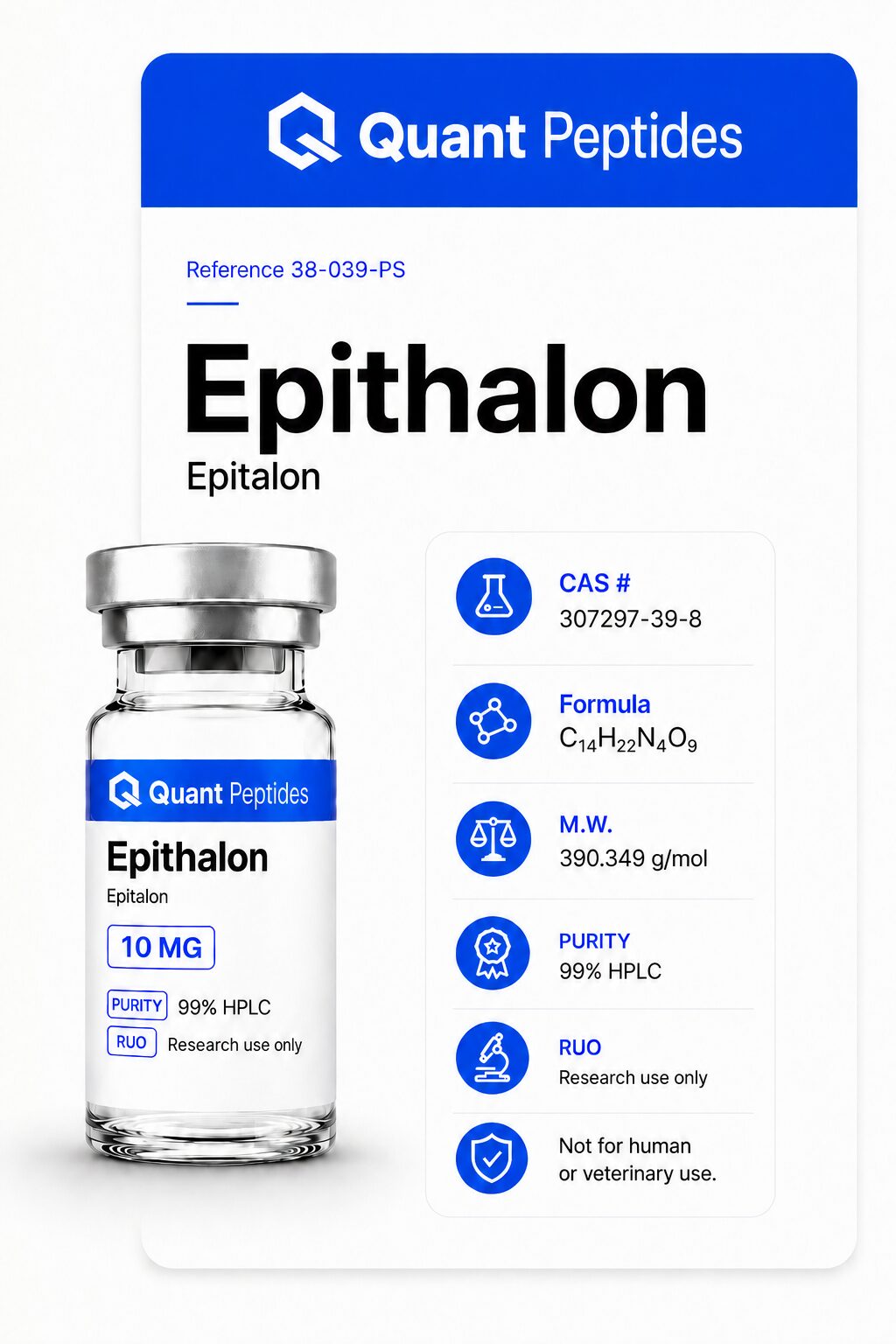
Epithalon (Epitalon) 10mg

Epithalon, also known as Epitalon, is a synthetic peptide derived from Epithalamin. It has been studied for its potential role in telomerase modulation, a process involved in maintaining and protecting telomeres, the protective caps located at the ends of chromosomes.

Research suggests that Epithalon may support telomere elongation by influencing telomerase activity. Because telomeres are closely associated with cellular aging and genomic stability, Epithalon has become an area of interest in longevity, cellular repair, and age-related research.

$95.00

Buy 5 and save 4%
$91.20 each
Buy 10 and save 8%
$87.40 each

What Is Epithalon? A Research Overview

Epithalon, also known as Epitalon, Epithalone, or Epithalamin, is a short synthetic peptide first developed in Russia in the 1980s. It has been studied for its potential role in telomerase activation, melatonin regulation, DNA protection, and age-related cellular processes.

Research suggests that Epithalon may help influence telomerase activity, an enzyme involved in maintaining telomeres, the protective caps at the ends of chromosomes. Because telomere shortening is closely linked to cellular aging, Epithalon has become a major area of interest in longevity and anti-aging research.

Animal studies have explored Epithalon for its potential to delay age-related changes in the immune and reproductive systems, as well as its possible effects on lifespan in mice and rats. Additional research has investigated Epithalon in areas related to cancer biology, infectious disease, melatonin signaling, and DNA regulation.

Epithalon Structure

Sequence: Ala-Glu-Asp-Gly
Molecular Formula: C14H22N4O9
Molecular Weight: 390.349 g/mol
PubChem CID: 219042
CAS Number: 307297-39-8

Epithalon and Longevity Research

How Epithalon May Influence Telomerase Activity

Early research in insects and rodents suggests that Epithalon may influence longevity-related pathways. In studies involving healthy fruit flies and rats, Epithalon was associated with reduced mortality rates. In mouse models predisposed to heart disease and cancer, Epithalon was also associated with increased lifespan compared with control groups. Researchers believe that part of this effect may be related to Epithalon’s ability to reduce free-radical activity, which can contribute to cellular damage over time. [1]

Epithalon’s potential anti-aging effects may also involve more than antioxidant activity alone. In vitro studies using human somatic cells suggest that Epithalon may activate telomerase, an enzyme involved in maintaining telomeres. Telomeres are protective structures located at the ends of chromosomes and play an important role in preserving DNA stability. [2]

By supporting telomerase activity, Epithalon may help protect telomeres and reduce the accumulation of DNA damage over time. Research suggests this may contribute to fewer errors within DNA strands, supporting the idea that Epithalon may help maintain genomic stability. [3] [4]

Because DNA damage and telomere shortening are closely associated with cellular aging, dysfunction, and certain disease processes, Epithalon remains an important area of interest in telomere, longevity, and cellular aging research.

How Epithalon May Influence DNA Activity

Epithalon’s effects on free radicals and telomeres may not fully explain its broader role in longevity research. Scientists continue to investigate how such a short peptide may influence complex biological processes, and one emerging area of interest is its potential effect on gene expression.

Cell culture research suggests that Epithalon may interact directly with DNA and influence the activity of specific genes. Studies indicate that Epithalon can interact with promoter regions of genes such as CD5, IL-2, MMP2, and Tram1. These genes are involved in important biological functions, including immune regulation, tissue remodeling, and cellular repair. [5]

CD5 and IL-2 are both associated with immune system activity, while MMP2 plays a key role in maintaining the extracellular matrix found in skin, tendons, and connective tissue. These findings suggest that Epithalon may support pathways related to immune function, tissue maintenance, and the body’s ability to respond to injury or everyday cellular stress.

Additional research in aging rats suggests that Epithalon may increase the expression of interferon gamma in aging lymphocytes. Interferon gamma is an important immune signaling molecule involved in antiviral defense and immune activation. It helps regulate macrophages, natural killer cells, and T cells, all of which play essential roles in protecting the body from infection and maintaining immune surveillance. [6]

Together, these findings suggest that Epithalon may influence longevity-related processes not only through telomerase and antioxidant pathways, but also through DNA regulation, immune signaling, and tissue-repair mechanisms.

The following are known DNA interactions of epithalon:

1

CD5 – Leads to immune cell differentiation

2

IL-2 – Increases IL-2 production, which regulates white blood cells

3

MMP2 – Enhances MMP activation and decreases inflammation

4

Tram1 – Enhances protein production

5

Arylalkylamine-N-acetyltransferase – Enhances melatonin production

6

pCREB t – Circadian rhythm regulation and anti-neoplastic effects

7

Telomerase – Telomerase activity increases cell longevity

How Epithalon May Support Skin Health and Cellular Aging

As noted above, Epithalon has been studied for its potential influence on MMP2, a protein involved in connective tissue structure and remodeling. MMP2 plays an important role in tissues such as skin, where it helps support the extracellular matrix, the structural network that includes collagen, elastin, and other key skin-supporting components.

Research in rodents suggests that Epithalon may not only activate genes related to MMP2, but may also stimulate fibroblasts, the cells responsible for producing and maintaining collagen, elastin, and other extracellular matrix proteins. In mouse studies, Epithalon exposure was associated with a 30–45% increase in fibroblast activation. [7]

By supporting fibroblast activity, Epithalon may help promote tissue repair, skin renewal, and the maintenance of skin structure. This makes it an area of interest in research related to wound healing, skin aging, and the gradual decline in skin integrity that occurs over time.

Additional research suggests that Epithalon may also help protect skin cells by reducing caspase-3 activity. Caspase-3 is an enzyme involved in apoptosis, also known as programmed cell death. By decreasing caspase-3 activity, Epithalon may help support the survival and longevity of fibroblasts and other skin-related cells. [8]

Together, these findings suggest that Epithalon may influence skin health through multiple pathways, including fibroblast activation, extracellular matrix support, and protection against premature cellular breakdown.

Epithalon May Influence Tumor Growth Research

Daily administration of Epithalon has been studied in rat models of cancer, where researchers observed a reduction in tumor growth compared with controls. In addition to slowing tumor development, Epithalon has also been investigated for its potential role in reducing metastasis, or the spread of cancer cells to distant tissues. [9] [10] [11]

Research has explored Epithalon in several cancer-related models, including HER2/neu-positive breast cancer, certain forms of leukemia, and testicular cancer. These studies suggest that Epithalon may influence pathways involved in abnormal cell growth, tumor progression, and cancer-related immune regulation. [12] [13]

While these findings are promising within research models, more studies are needed to better understand how Epithalon affects tumor biology, whether these effects translate across different cancer types, and what mechanisms may be involved.

Research suggests that Epithalon may help activate the gene responsible for producing PER1, a protein found in the hypothalamus that plays an important role in regulating circadian rhythm. PER1 is involved in the body’s internal timing system, which helps coordinate sleep-wake cycles, hormone release, metabolism, and cellular repair.

PER1 has also become an area of interest in cancer research because it is often under-expressed in cancer patients. It is not yet fully understood whether reduced PER1 expression occurs before cancer development and contributes to tumor growth, or whether it develops as a result of the cancer process itself. However, research suggests that once cancer is present, PER1 may influence how tumors grow and respond to treatment.

Studies indicate that increasing PER1 expression may help sensitize cancer cells to radiation. This could potentially allow researchers to explore lower radiation doses while still maintaining therapeutic effects. In theory, this may help reduce immediate side effects and lower the risk of secondary tumors associated with high-dose radiation exposure. [14]

These findings suggest that Epithalon may influence cancer-related pathways not only through telomerase and DNA regulation, but also through circadian rhythm genes such as PER1, which may play a role in tumor behavior, radiation sensitivity, and cellular timing mechanisms.

How Epithalon May Influence Melatonin and Circadian Rhythm

Melatonin is a hormone produced by the pineal gland and is closely involved in sleep regulation, circadian rhythm, and aging-related biological processes. Research in rats suggests that Epithalon and related peptides may influence both the synthesis and release of melatonin by affecting proteins involved in melatonin production. [15]

Two important proteins studied in this pathway are arylalkylamine-N-acetyltransferase, also known as AANAT, and pCREB transcription protein. AANAT plays a key role in melatonin synthesis, while pCREB is involved in regulating gene activity connected to circadian signaling and melatonin release. [15]

Research in monkeys has also shown that Epithalon may help restore melatonin secretion toward normal patterns. Because melatonin production often changes with age, these findings make Epithalon an area of interest in circadian rhythm, sleep-wake cycle, pineal gland, and longevity-related research. [16]

Epithalon May Support Eyesight and Vision Research

Research in rat models of retinitis pigmentosa suggests that Epithalon may help support retinal structure and visual function. In one study, Epithalon was associated with improved outcomes in approximately 90% of treated subjects. [17]

The peptide appeared to help preserve the normal structure of the eye while also supporting the bioelectric activity of the retina, which is essential for vision signaling. These findings have made Epithalon an area of interest in research related to retinal health, age-related vision changes, and degenerative eye conditions.

Epithalon has demonstrated minimal side effects in mouse studies, along with low oral bioavailability and strong subcutaneous bioavailability. However, dosing data from animal studies does not directly translate to humans.

Epithalon sold by Quant Peptides is intended strictly for educational and scientific research purposes only. It is not for human consumption and should only be purchased by licensed researchers.


Article Author

The above literature was researched, edited and organized by Dr. Logan, M.D. Dr. Logan holds a doctorate degree from Case Western Reserve University School of Medicine and a B.S. in molecular biology.

Scientific Journal Article

Vladimir Khavinson is a Professor, President of the European region of the International Association of Gerontology and Geriatrics; Member of the Russian and Ukrainian Academies of Medical Sciences; Main gerontologist of the Health Committee of the Government of Saint Petersburg, Russia; Director of the Saint Petersburg Institute of Bioregulation and Gerontology; Vice-president of Gerontological Society of the Russian Academy of Sciences; Head of the Chair of Gerontology and Geriatrics of the North-Western State Medical University, St-Petersburg; Colonel of medical service (USSR, Russia), retired. Vladimir Khavinson is known for the discovery, experimental and clinical studies of new classes of peptide bioregulators as well as for the development of bioregulating peptide therapy. He is engaged in studying of the role of peptides in regulation of the mechanisms of ageing. His main field of actions is design, pre-clinical and clinical studies of new peptide geroprotectors. A 40-year-long investigation resulted in a multitude of methods of application of peptide bioregulators to slow down the process of ageing and increase human life span. Six peptide-based pharmaceuticals and 64 peptide food supplements have been introduced into clinical practice by V. Khavinson. He is an author of 196 patents (Russian and international) as well as of 775 scientific publications. His major achievements are presented in two books: “Peptides and Ageing” (NEL, 2002) and “Gerontological aspects of genome peptide regulation” (Karger AG, 2005). Vladimir Khavinson introduced scientific specialty “Gerontology and Geriatrics” in the Russian Federation on the governmental level. Academic Council headed by V. Khavinson has oversighted over 200 Ph.D. and Doctorate theses from many different countries.

Prof. Vladimir Khavinson is being referenced as one of the leading scientists involved in the research and development of Epitalon. In no way is this doctor/scientist endorsing or advocating the purchase, sale, or use of this product for any reason. There is no affiliation or relationship, implied or otherwise, between Quant Peptides and this doctor. The purpose of citing the doctor is to acknowledge, recognize, and credit the exhaustive research and development efforts conducted by the scientists studying this peptide. Prof. Vladimir Khavinson is listed in [1] [2] [5] [6] [7] [9] [12] [13] [15] and [17] under the referenced citations.

Referenced Citations

1

V. N. Anisimov, S. V. Mylnikov, and V. K. Khavinson, “Pineal peptide preparation epithalamin increases the lifespan of fruit flies, mice and rats,” Mech. Ageing Dev., vol. 103, no. 2, pp. 123–132, Jun. 1998. [PubMed]

2

V. K. Khavinson, I. E. Bondarev, and A. A. Butyugov, “Epithalon peptide induces telomerase activity and telomere elongation in human somatic cells,” Bull. Exp. Biol. Med., vol. 135, no. 6, pp. 590–592, Jun. 2003. [PubMed]

3

T. A. Dzhokhadze, T. Z. Buadze, M. N. Gaiozishvili, M. A. Rogava, and T. A. Lazhava, “[Functional regulation of genome with peptide bioregulators by hypertrophic cardiomyopathy (by patients and relatives)],” Georgian Med. News, no. 225, pp. 94–97, Dec. 2013. [PubMed]

4

V. N. Anisimov et al., “Effect of Epitalon on biomarkers of aging, life span and spontaneous tumor incidence in female Swiss-derived SHR mice,” Biogerontology, vol. 4, no. 4, pp. 193–202, 2003. [PubMed]

5

V. K. Khavinson, S. I. Tarnovskaya, N. S. Linkova, V. E. Pronyaeva, L. K. Shataeva, and P. P. Yakutseni, “Short cell-penetrating peptides: a model of interactions with gene promoter sites,” Bull. Exp. Biol. Med., vol. 154, no. 3, pp. 403–410, Jan. 2013. [PubMed]

6

N. S. Lin’kova, B. I. Kuznik, and V. K. Khavinson, “[Peptide Ala-Glu-Asp-Gly and interferon gamma: their role in immune response during aging],” Adv. Gerontol. Uspekhi Gerontol., vol. 25, no. 3, pp. 478–482, 2012. [PubMed]

7

N. I. Chalisova, N. S. Lin’kova, A. N. Zhekalov, A. O. Orlova, G. A. Ryzhak, and V. K. Khavinson, “[Short peptides stimulate skin cell regeneration during ageing],” Adv. Gerontol. Uspekhi Gerontol., vol. 27, no. 4, pp. 699–703, 2014. [PubMed]

8

N. S. Lin’kova et al., “Peptide Regulation of Skin Fibroblast Functions during Their Aging In Vitro,” Bull. Exp. Biol. Med., vol. 161, no. 1, pp. 175–178, May 2016. [PubMed]

9

I. A. Vinogradova, A. V. Bukalev, M. A. Zabezhinski, A. V. Semenchenko, V. K. Khavinson, and V. N. Anisimov, “Effect of Ala-Glu-Asp-Gly peptide on life span and development of spontaneous tumors in female rats exposed to different illumination regimes,” Bull. Exp. Biol. Med., vol. 144, no. 6, pp. 825–830, Dec. 2007. [PubMed[

10

G. Kossoy, V. N. Anisimov, H. Ben-Hur, N. Kossoy, and I. Zusman, “Effect of the synthetic pineal peptide epitalon on spontaneous carcinogenesis in female C3H/He mice,” Vivo Athens Greece, vol. 20, no. 2, pp. 253–257, Apr. 2006. [PubMed]

11

V. N. Anisimov et al., “Inhibitory effect of the peptide epitalon on the development of spontaneous mammary tumors in HER-2/neu transgenic mice,” Int. J. Cancer, vol. 101, no. 1, pp. 7–10, 2002. [PubMed]

12

V. N. Anisimov, V. K. Khavinson, I. N. Alimova, A. V. Semchenko, and A. I. Yashin, “Epithalon decelerates aging and suppresses development of breast adenocarcinomas in transgenic her-2/neu mice,” Bull. Exp. Biol. Med., vol. 134, no. 2, pp. 187–190, Aug. 2002. [PubMed]

13

I. A. Vinogradova, A. V. Bukalev, M. A. Zabezhinski, A. V. Semenchenko, V. K. Khavinson, and V. N. Anisimov, “Geroprotective effect of ala-glu-asp-gly peptide in male rats exposed to different illumination regimens,” Bull. Exp. Biol. Med., vol. 145, no. 4, pp. 472–477, Apr. 2008. [PubMed]

14

S. Gery, N. Komatsu, L. Baldjyan, A. Yu, D. Koo, and H. P. Koeffler, “The circadian gene per1 plays an important role in cell growth and DNA damage control in human cancer cells,” Mol. Cell, vol. 22, no. 3, pp. 375–382, May 2006. [PubMed]

15

V. K. Khavinson, L. K. Shataeva, and A. A. Chernova, “Effect of regulatory peptides on gene transcription,” Bull. Exp. Biol. Med., vol. 136, no. 3, pp. 288–290, Sep. 2003. [PubMed]

16

O. V. Korkushko et al., “[Normalizing effect of the pineal gland peptides on the daily melatonin rhythm in old monkeys and elderly people],” Adv. Gerontol. Uspekhi Gerontol., vol. 20, no. 1, pp. 74–85, 2007. [PubMed]

17

V. Khavinson, M. Razumovsky, S. Trofimova, R. Grigorian, and A. Razumovskaya, “Pineal-regulating tetrapeptide epitalon improves eye retina condition in retinitis pigmentosa,” Neuro Endocrinol. Lett., vol. 23, no. 4, pp. 365–368, Aug. 2002. [PubMed]

ALL ARTICLES AND PRODUCT INFORMATION PROVIDED ON THIS WEBSITE ARE FOR INFORMATONAL AND EDUCATIONAL PURPOSES ONLY.

The products offered on this website are furnished for in-vitro studies only. In-vitro studies (Latin: in glass) are performed outside of the body. These products are not medicines or drugs and have not been approved by the FDA to prevent, treat or cure any medical condition, ailment or disease. Bodily introduction of any kind into humans or animals is strictly forbidden by law.

COA

Storage Instructions:

Storage & Stability

Our peptides are produced using a specialized freeze-drying process known as lyophilization. This process removes moisture from the peptide while preserving its structure, helping maintain stability during storage and shipping.

Before reconstitution, lyophilized peptides are typically presented as a dry, white powder or cake inside the vial. In this form, they are generally more stable than liquid peptides and can better tolerate short-term temperature changes that may occur during transit.

Once received, peptides should be stored in a cool, dry place away from direct light. For short-term storage, refrigeration at approximately 4°C / 39°F is commonly recommended. For longer-term storage, keeping lyophilized peptides frozen may help preserve their stability over time.

After the peptide is reconstituted with bacteriostatic water, it should be stored in the refrigerator and protected from light. Reconstituted peptides are generally recommended for use within 30 days to help maintain quality and stability.

In simple terms:
Lyophilized peptides are designed to remain stable while dry, but once mixed, they should be kept cold and handled with care.