Product Usage: This PRODUCT IS INTENDED AS A RESEARCH CHEMICAL ONLY. This designation allows the use of research chemicals strictly for in vitro testing and laboratory experimentation only. All product information available on this website is for educational purposes only. Bodily introduction of any kind into humans or animals is strictly forbidden by law. This product should only be handled by licensed, qualified professionals. This product is not a drug, food, or cosmetic and may not be misbranded, misused or mislabeled as a drug, food or cosmetic.

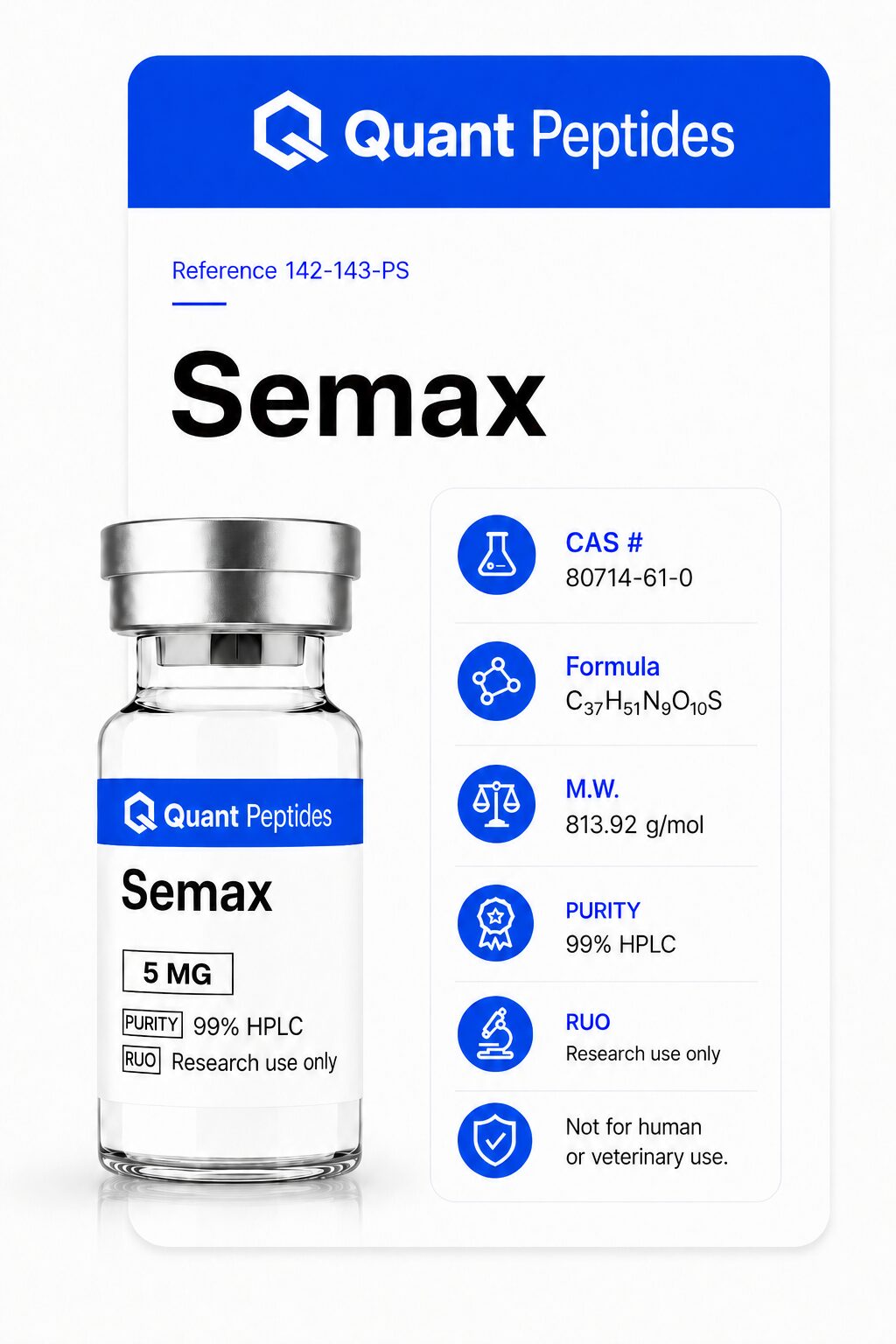
Semax 5mg

Semax is a synthetic peptide derived from adrenocorticotropic hormone, also known as ACTH. It has been studied for its potential nootropic and neuroprotective properties, including its possible effects on memory, focus, cognitive performance, and neurological recovery pathways. Research has also explored Semax in post-stroke rehabilitation settings. Unlike traditional stimulant-based compounds, Semax is not generally associated with jitteriness or overstimulation in available research.

$79.00

Buy 3 and save 3%
$76.63 each
Buy 5 and save 6%
$74.26 each
Buy 10 and save 8%
$72.68 each

Semax Overview

Semax is a synthetic peptide originally developed in Russia and studied for its potential neuroprotective, cognitive, and mood-related effects. Research has explored its use in areas such as stroke recovery, cognitive decline, dementia, optic nerve inflammation, and immune system modulation.

Studies suggest that Semax may influence several important pathways in the central nervous system, including the regulation of brain-derived neurotrophic factor, also known as BDNF, a protein involved in neuron growth, repair, and overall brain plasticity. Semax has also been studied for its potential effects on neurotransmitters such as serotonin and dopamine, which are associated with mood, motivation, and cognitive function.

Additional research has investigated Semax for its possible antidepressant and anxiolytic properties, making it an area of interest in both neurological and mood-related research.

Semax Structure

Sequence: Met-Glu-His-Phe-Pro-Gly-Pro
Molecular Formula: C37H51N9O10S
Molecular Weight: 813.92 g/mol
CAS Number: 80714-61-0
Synonyms: Pro-Gly-Pro-ACTH

What Is Semax?

Semax is a synthetic peptide analogue derived from adrenocorticotropic hormone, also known as ACTH. It is composed of the 4–10 amino acid fragment of ACTH, a sequence that has been studied for its potential neurological and cognitive effects.

Semax Research

How Semax May Influence Resting Brain Structure

Functional magnetic resonance imaging research has shown that Semax may influence activity within the default mode network, a group of brain regions that are typically more active during rest than during focused task performance. Although the default mode network is still not fully understood, current research suggests that it may play an important role in social cognition, environmental awareness, and the brain’s ability to shift from a resting state into a more focused state. [1] [2]

The default mode network can be thought of as part of the brain’s background monitoring system. When the mind is not focused on a specific task, this network helps maintain awareness of the surrounding environment and may support readiness to respond to new information, especially in social situations. Disruption of this network has been observed in cognitive disorders such as Alzheimer’s disease, further suggesting its importance in memory, awareness, and overall cognitive function. [2]

By supporting activity within the default mode network, Semax may help promote a more alert resting state. This could make the brain more responsive to environmental and social cues, allowing for a smoother transition from rest to focused attention. In this way, Semax may support the brain’s ability to monitor surroundings and engage attention when needed.

Increased activity within the default mode network is also associated with stronger communication between different regions of the brain. Greater interconnectivity has been linked to cognitive functions such as memory, problem-solving, and creativity. While more direct research is needed to determine whether Semax specifically improves global brain connectivity, its observed effects on resting-state brain networks make it an area of continued interest in cognitive and neurological research.


How Semax May Influence Recovery After Stroke

Semax has been used in Russia in research and clinical settings related to acute cerebral hypoxia, a condition in which the brain receives insufficient oxygen. This can occur during events such as stroke or traumatic brain injury.

Preclinical research in rats suggests that Semax may influence several molecular pathways involved in gene activity within the central nervous system. In one study, Semax was associated with changes in the expression of 24 genes related to vascular function in the brain and spinal cord. These genes are involved in processes such as smooth muscle cell migration, red blood cell formation, blood vessel development, and overall vascular regulation. These effects may help explain why Semax has been studied for its potential neuroprotective properties in stroke-related models. Research suggests it may help support neuron survival, stabilize mitochondrial function, improve cellular energy production, and promote better nutrient delivery to brain tissue. [3]

Clinical research conducted in Russia has also evaluated Semax in patients undergoing rehabilitation after stroke. These studies suggest that Semax may help accelerate functional recovery and improve overall outcomes following therapy. According to Gusev et al., early rehabilitation combined with Semax administration was associated with increased plasma levels of brain-derived neurotrophic factor, also known as BDNF, along with faster functional recovery and improved motor performance. [4]

BDNF is an important naturally occurring protein involved in learning, memory, and neuroplasticity. By supporting BDNF activity, Semax may help the brain adapt after injury by encouraging undamaged regions to take on functions previously managed by damaged areas. Semax has also been studied for its effect on the default mode network, a brain network involved in resting awareness, attention, and social function. Together, these mechanisms make Semax an area of continued interest in stroke-related and neurorecovery research.

How Semax May Support Brain Gene Activity

The effects of Semax on brain gene expression have not only been studied in stroke-related models. Research in healthy rats suggests that a single intranasal dose of Semax may influence the activity of multiple genes in both the hippocampus and the frontal cortex. These two brain regions are especially important because the hippocampus plays a central role in learning and memory, while the frontal cortex is involved in attention, planning, decision-making, and organizing information.

In these studies, changes in gene expression were observed within 20 minutes of Semax administration. The most notable effects were seen in genes related to nerve growth factor, also known as NGF, and brain-derived neurotrophic factor, or BDNF. Both NGF and BDNF are important neurotrophic factors involved in neuron support, brain plasticity, learning, and adaptive repair processes. [5]

Because Semax appears to influence gene activity in brain regions tied to learning, concentration, and executive function, researchers have continued to explore its potential role in cognitive-related pathways. These findings suggest that Semax may offer insight into how the brain processes information, adapts to new experiences, and supports longer-term learning and memory formation.

How Semax May Support Focus, Memory, and Mental Performance

Semax has been studied for its potential role in learning, memory, and cognitive performance, particularly in models involving neurological impairment. Because Semax is derived from a fragment of adrenocorticotropic hormone, or ACTH, researchers have also examined the cognitive effects of ACTH-related peptides.

Research from Canada, the United States, and China has found that ACTH may help protect learning and memory function in mouse models of epilepsy. ACTH has long been used in certain epileptic disorders, particularly where there is concern for developmental regression or impaired neurological function. These findings have led researchers to explore whether ACTH-derived peptides, such as Semax, may influence cognitive protection and recovery pathways. [6]

According to Dr. Scantlebury, Semax may be a highly effective ACTH derivative with potential advantages over the naturally occurring peptide. While additional research is still needed, studies suggest that ACTH may help reduce learning and memory dysfunction associated with seizure activity, even at lower doses.

These findings have raised interest in whether ACTH-related peptides, including Semax, may have nootropic-like properties. Researchers continue to investigate whether Semax may help support learning, memory, and cognitive performance, especially in conditions where these functions are impaired.

How Semax May Influence Mood and Depression-Related Pathway

Research in mice suggests that increasing brain-derived neurotrophic factor, also known as BDNF, may help support healthier brain function in depression-related models. BDNF plays an important role in neuroplasticity, neuron survival, and the formation of new neural connections, all of which are areas of interest in mood and cognitive research.

Traditional antidepressants, such as selective serotonin reuptake inhibitors or SSRIs, primarily affect serotonin signaling. However, these medications often require several weeks before noticeable effects are observed. This delayed response has led researchers to investigate whether the therapeutic effects of SSRIs may involve more than serotonin alone.

One emerging theory is that SSRIs may help improve mood over time by increasing BDNF activity and supporting neurogenesis, or the formation of new neurons, in brain regions affected by depression. Because Semax has been studied for its potential influence on BDNF-related pathways, researchers have explored whether BDNF-supporting compounds may provide new insight into depression-related mechanisms. [7]

Deltheil et al. suggested that combining BDNF-stimulating compounds with SSRI treatment could potentially improve therapeutic outcomes, although additional research is needed to confirm whether these findings can be replicated and applied more broadly. This area remains an active field of investigation, especially for understanding how neuroplasticity, neurotransmitters, and mood regulation may be connected.

Semax has demonstrated minimal side effects in mouse studies, along with low oral bioavailability and strong subcutaneous bioavailability. However, dosing data from animal studies does not directly translate to humans.


Semax sold by Quant Peptides is intended strictly for educational and scientific research purposes only. It is not for human consumption and should only be purchased by licensed researchers.

Article Author

The above literature was researched, edited and organized by Dr. Logan, M.D. Dr. Logan holds a doctorate degree from Case Western Reserve University School of Medicine and a B.S. in molecular biology.

Scientific Journal Author

Dr. Igor Ivanovich Bobyntsev researches at the Kursk State Medical University within the Department of Pathophysiology. His main goal is to find new, more effective methods for teaching morphological disciplines… such as histology, cytology, embryology, human anatomy, pathological anatomy, the study of the morphological manifestation of stress-limiting effects of neuropeptides and their synthetic analogues. His key interests pertain to Antioxidants, Free Radicals, Antioxidant Activity, Free Radical Scavengers, Reactive Oxygen Species, Lipid Peroxidation, SOD, Oxidative Stress Biomarkers, Inflammatory Biomarkers, and Oxidative Stress. He specifically studied the influence of Semax on the morphofunctional state of hepatocytes, and lipid peroxidation in the liver, when under chronic emotional and painful stress.

Dr. Igor Ivanovich Bobyntsev is being referenced as one of the leading scientists involved in the research and development of Semax. In no way is this doctor/scientist endorsing or advocating the purchase, sale, or use of this product for any reason. There is no affiliation or relationship, implied or otherwise, between Quant Peptides and this doctor. The purpose of citing the doctor is to acknowledge, recognize, and credit the exhaustive research and development efforts conducted by the scientists studying this peptide. Dr. Igor Ivanovich Bobyntsev is listed in [8] and [9] under the referenced citations.

Referenced Citations

1

I. S. Lebedeva et al., “Effects of Semax on the Default Mode Network of the Brain,” Bull. Exp. Biol. Med., vol. 165, no. 5, pp. 653–656, Sep. 2018. [PubMed]

2

R. B. Mars, F.-X. Neubert, M. P. Noonan, J. Sallet, I. Toni, and M. F. S. Rushworth, “On the relationship between the ‘default mode network’ and the ‘social brain,’” Front. Hum. Neurosci., vol. 6, 2012. [PMC]

3

E. V. Medvedeva et al., “The peptide semax affects the expression of genes related to the immune and vascular systems in rat brain focal ischemia: genome-wide transcriptional analysis,” BMC Genomics, vol. 15, p. 228, Mar. 2014. [PubMed]

4

E. I. Gusev, M. Y. Martynov, E. V. Kostenko, L. V. Petrova, and S. N. Bobyreva, “[The efficacy of semax in the tretament of patients at different stages of ischemic stroke],” Zh. Nevrol. Psikhiatr. Im. S. S. Korsakova, vol. 118, no. 3. Vyp. 2, pp. 61–68, 2018. [PubMed]

5

T. I. Agapova et al., “[Effect of semax on the temporary dynamics of brain-derived neurotrophic factor and nerve growth factor gene expression in the rat hippocampus and frontal cortex],” Mol. Genet. Mikrobiol. Virusol., no. 3, pp. 28–32, 2008. [PubMed]

6

M. H. Scantlebury, K.-C. Chun, S.-C. Ma, J. M. Rho, and D. Y. Kim, “Adrenocorticotropic Hormone Protects Learning and Memory Function in Epileptic Kcna1-null mice,” Neurosci. Lett., vol. 645, pp. 14–18, Apr. 2017. [PubMed]

7

T. Deltheil et al., “Behavioral and serotonergic consequences of decreasing or increasing hippocampus brain-derived neurotrophic factor protein levels in mice,” Neuropharmacology, vol. 55, no. 6, pp. 1006–1014, Nov. 2008. [PubMed]

8

Ivanov, Alexander & Bobyntsev, Igor & Shepeleva, Olga & Kryukov, Alexey & Andreeva, L & Myasoedov, N. (2017). Influence of ACTG4-7-PGP (Semax) on Morphofunctional State of Hepatocytes in Chronic Emotional and Painful Stress. Bulletin of experimental biology and medicine. 163. [Research Gate]

9

Bobyntsev, Igor & Kryukov, Alexey & Shepeleva, Olga & Ivanov, Alexander. (2015). The effect of ACTH-4-7-PGP peptide on lipid peroxidation in liver and activity of serum transaminases in rats under acute and chronic immobilization stress conditions. 78. 18-21. [Research Gate]

ALL ARTICLES AND PRODUCT INFORMATION PROVIDED ON THIS WEBSITE ARE FOR INFORMATIONAL AND EDUCATIONAL PURPOSES ONLY.

The products offered on this website are furnished for in-vitro studies only. In-vitro studies (Latin: in glass) are performed outside of the body.  These products are not medicines or drugs and have not been approved by the FDA to prevent, treat or cure any medical condition, ailment or disease.  Bodily introduction of any kind into humans or animals is strictly forbidden by law.

Certificate of Analysis (COA)

High Performance Liquid Chromatography (HPLC)

Mass Spectrometry (MS)

Storage Instructions:

Storage & Stability

Our peptides are produced using a specialized freeze-drying process known as lyophilization. This process removes moisture from the peptide while preserving its structure, helping maintain stability during storage and shipping.

Before reconstitution, lyophilized peptides are typically presented as a dry, white powder or cake inside the vial. In this form, they are generally more stable than liquid peptides and can better tolerate short-term temperature changes that may occur during transit.

Once received, peptides should be stored in a cool, dry place away from direct light. For short-term storage, refrigeration at approximately 4°C / 39°F is commonly recommended. For longer-term storage, keeping lyophilized peptides frozen may help preserve their stability over time.

After the peptide is reconstituted with bacteriostatic water, it should be stored in the refrigerator and protected from light. Reconstituted peptides are generally recommended for use within 30 days to help maintain quality and stability.

In simple terms:
Lyophilized peptides are designed to remain stable while dry, but once mixed, they should be kept cold and handled with care.