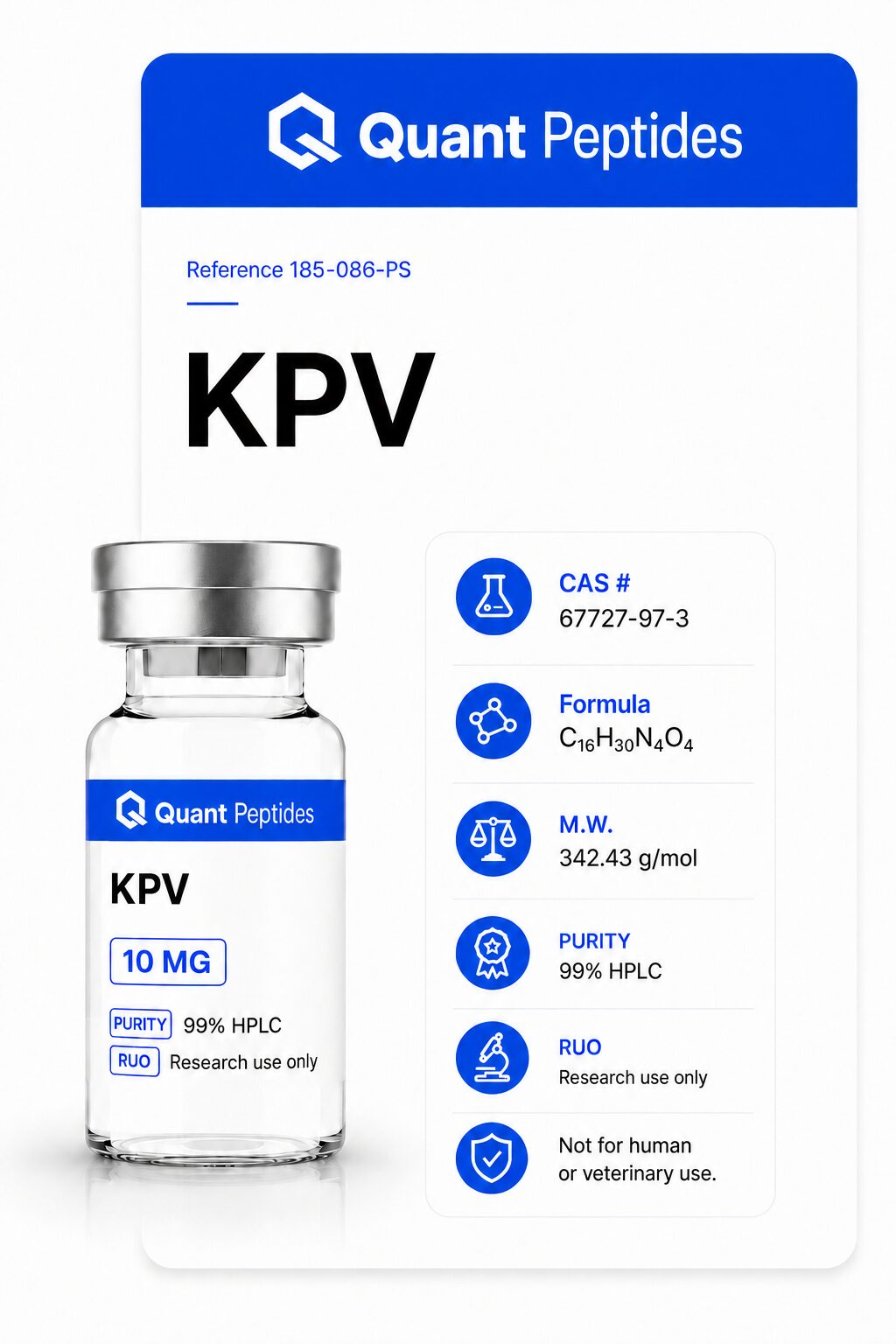
Product Usage: This PRODUCT IS INTENDED AS A RESEARCH CHEMICAL ONLY. This designation allows the use of research chemicals strictly for in vitro testing and laboratory experimentation only. All product information available on this website is for educational purposes only. Bodily introduction of any kind into humans or animals is strictly forbidden by law. This product should only be handled by licensed, qualified professionals. This product is not a drug, food, or cosmetic and may not be misbranded, misused or mislabeled as a drug, food or cosmetic.

KPV 10mg

Ac-KPV-NH2, also known as KPV, is a potent anti-inflammatory peptide derived from alpha-melanocyte-stimulating hormone, or alpha-MSH. It has been studied for its potential role in regulating inflammation across several research models, with some of the most active research focused on inflammatory bowel disease.

Research suggests that KPV may help support inflammatory balance, tissue repair, and wound-healing pathways. Studies involving Ac-KPV-NH2 and other alpha-MSH derivatives have explored their potential to reduce inflammation, support wound closure, limit infection-related complications, and improve overall healing outcomes.

Because of these repair-focused properties, KPV remains an area of interest in wound healing, post-injury recovery, and scar-related research. Current findings suggest that peptides in this class may have potential applications not only in tissue repair, but also in improving cosmetic outcomes following injury or surgery.

$109.00

Buy 3 and save 4%
$104.64 each
Buy 5 and save 6%
$102.46 each
Buy 10 and save 10%
$98.10 each

Ac-KPV-NH2

Ac-KPV-NH2, also known as KPV, is the C-terminal peptide fragment of alpha-melanocyte-stimulating hormone, commonly referred to as alpha-MSH. It is composed of three amino acids: lysine, proline, and valine.

KPV is one of several short alpha-MSH-derived peptides studied to determine whether these smaller fragments retain certain biological properties of the parent hormone, including anti-inflammatory activity, photoprotective effects, ischemia-related effects, and potential roles in feeding behavior and energy homeostasis. Among these derivatives, Ac-KPV-NH2 has gained attention for its significant anti-inflammatory activity. [1]

Research has explored KPV as a potential therapeutic target in inflammatory bowel disease, where it has shown promising anti-inflammatory effects. Additional studies suggest that KPV may help regulate inflammatory activity in multiple tissue systems, including the central nervous system, gastrointestinal tract, lungs, vascular system, and joints.

Because KPV is a small peptide, it has been studied through several administration routes, including oral, intravenous, and transdermal delivery. This versatility has made it an active area of research in inflammation, tissue protection, and immune-modulation pathways.

Ac-KPV-NH2

Amino Acid Sequence: Lys-Pro-Val
Molecular Formula: C17H32N6O4
Molecular Weight: 384.48 g/mol
PubChem CID: 125672
CAS Number: 112965-21-6
Synonyms: MSH (11-13), ACTH(11-13), alpha-MSH(11-13)

KPV Peptide Research

How KPV May Support Intestinal Inflammation Research

One of the most significant areas of research involving Ac-KPV-NH2, also known as KPV, is its potential role in reducing intestinal inflammation. In mouse models of inflammatory bowel disease, or IBD, KPV has shown promising anti-inflammatory effects. Studies have reported reductions in inflammatory cell infiltration, myeloperoxidase activity, and overall histological signs of intestinal inflammation. Mice treated with KPV also demonstrated faster recovery and greater weight gain compared with placebo-treated controls. [2]

Additional research has explored improved delivery methods for KPV. One approach involves loading KPV onto nanoparticles functionalized with hyaluronic acid, which may help direct the peptide more effectively to inflamed areas within the intestine. In mouse models, this targeted delivery method was associated with accelerated mucosal healing and reduced inflammation, partly through strong downregulation of TNF-alpha, a key inflammatory signaling molecule. [3]

This targeted approach may allow KPV to reduce intestinal inflammation more locally, without broadly affecting TNF-alpha activity throughout the rest of the body. Researchers have also investigated modified KPV delivery systems to improve oral bioavailability. While these modifications may not necessarily make the peptide more effective overall, they may improve potency by helping more of the peptide reach the intended site of action at a lower required dose.

How KPV May Influence Inflammatory Signaling in the Intestine

Research suggests that Ac-KPV-NH₂, also known as KPV, may affect multiple inflammatory pathways beyond TNF-alpha alone. Studies indicate that KPV may also help reduce activity of NF-kappaB and mitogen-activated protein kinase, both of which are important signaling pathways involved in inflammation. [4]

These effects appear to work alongside TNF-alpha modulation to help reduce inflammatory changes within the intestine. In mouse models, treatment with KPV was associated with reduced colonic inflammatory infiltration and more normal colon lengths compared with untreated controls. [4]

Together, these findings suggest that KPV may support intestinal inflammatory balance through several coordinated mechanisms, making it an area of interest in gastrointestinal inflammation and inflammatory bowel disease research.

How KPV May Target Inflammation-Activated Intestinal Pathways

One notable finding from the graph above is that Ac-KPV-NH₂, also known as KPV, appears to have its strongest effect in the setting of elevated inflammation, while showing little to no effect in normal tissue. This suggests that KPV may act more selectively in inflamed environments rather than broadly altering healthy intestinal tissue.

Part of this targeted activity may be explained by how KPV enters colonic cells. Research led by Professor Didier Merlin has shown that KPV can enter intestinal cells through PepT1, a peptide transporter that is expressed at much higher levels during inflammatory states. Because PepT1 activity increases when the intestine is inflamed, KPV may be more effectively delivered into cells during active inflammation.

This mechanism may help explain why KPV appears more active in inflamed tissue while having minimal impact during normal or quiescent periods. It also raises interest in KPV as a potential maintenance-focused research compound in inflammatory bowel disease models, where the peptide may remain available during inflammatory flare activity while having limited effect when inflammation is low.

More broadly, this research points to an important drug-delivery concept: targeting transporters or proteins that become more active during disease states. By using disease-associated pathways for delivery, researchers may be able to concentrate therapeutic activity in affected tissues while reducing broader systemic exposure. This approach could support lower dosing, fewer off-target effects, and the development of compounds that become most useful under specific disease conditions.

How KPV May Support General Anti-Inflammatory Research

Research dating back to 1984 found that Ac-KPV-NH₂, also known as KPV, demonstrated anti-inflammatory and fever-reducing activity in rabbit models. In these early studies, KPV was less potent than the full alpha-melanocyte-stimulating hormone molecule, also known as alpha-MSH. This led researchers to believe that additional regions of alpha-MSH may contribute to its full anti-pyretic activity. [5]

These findings helped launch decades of research into alpha-MSH, KPV, and related peptide analogues. Studies have since explored these compounds across a wide range of inflammation-related models, including fever, irritant and allergic contact dermatitis, vasculitis, fibrosis, arthritis, and inflammation involving the eyes, brain, lungs, and gastrointestinal tract. [6]

Across these studies, alpha-MSH has generally shown strong anti-inflammatory activity. However, one limitation of the full alpha-MSH molecule is its association with skin pigmentation effects. KPV, by contrast, does not appear to share this pigmentation-related effect. Although KPV may be less potent than intact alpha-MSH in some models, its more targeted peptide structure and lack of pigmentation activity have made it an important focus in anti-inflammatory research. [6]

Further investigation suggests that many of alpha-MSH’s anti-inflammatory effects may be linked to the KPV portion of the molecule. However, alpha-MSH may have additional immune-modulating effects beyond the immediate inflammatory response. For example, in contact dermatitis models, KPV and alpha-MSH showed similar effects during early inflammation, such as swelling measured around 24 hours after exposure. At later time points, such as two weeks after initial exposure, alpha-MSH appeared more effective at reducing the delayed allergic inflammatory response. [7]

This suggests that while KPV may account for much of the immediate anti-inflammatory activity of alpha-MSH, the full alpha-MSH molecule may influence longer-term immune regulation through additional mechanisms. Researchers are still studying these pathways to better understand how KPV, alpha-MSH, and related peptides affect both early and late-stage inflammation.

KPV May Support Wound Healing Research

Wound healing is a complex biological process that generally occurs in three overlapping phases: inflammation, proliferation, and remodeling. Each phase involves different cell types, cytokines, and signaling pathways, creating distinct opportunities for research into tissue repair and recovery.

Studies suggest that many skin cells involved in wound healing express the melanocortin 1 receptor, or MC1R, which binds alpha-melanocyte-stimulating hormone, also known as alpha-MSH. Because Ac-KPV-NH₂, also known as KPV, is derived from alpha-MSH, it may interact with similar pathways involved in inflammation control, immune response, and tissue repair. [6]

KPV is of particular interest because it appears to retain some of alpha-MSH’s anti-inflammatory properties without the pigment-inducing activity associated with the parent molecule. This may make KPV a valuable research candidate for supporting wound-healing pathways while avoiding pigmentation-related effects that can influence scar appearance, especially in individuals more prone to visible pigmentation changes during healing.

Research also suggests that KPV may participate in innate immune defense against certain skin-related pathogens. Studies have shown that KPV can inhibit the growth of Staphylococcus aureus and Candida albicans at physiological concentrations. This is significant because many anti-inflammatory compounds may reduce inflammation while also weakening the body’s ability to fight infection. KPV, by contrast, has been studied for both anti-inflammatory and antimicrobial activity, making it especially interesting in wound-healing models such as burns and serious skin injuries. [8]

KPV has also served as a structural model in antifungal research. Scientists have investigated whether the peptide’s three-dimensional structure contributes to its antifungal effects, with the goal of developing new compounds that may reproduce this antimicrobial activity while producing different effects on other biological pathways. [9]

How KPV May Support Skin Remodeling and Scar Research

Based on its known role in the inflammatory phase of wound healing, Ac-KPV-NH₂, also known as KPV, has also been studied for its potential effects during the later stages of wound repair. Research suggests that KPV may help reduce the type of chronic inflammation that contributes to hypertrophic scars and keloid-like scar formation.

This type of scarring is often associated with increased macrophage infiltration, elevated TNF activity, and greater neutrophil presence within the affected tissue. In related studies, alpha-MSH administration was associated with smaller scars and a more controlled inflammatory response. Similar anti-fibrotic effects have also been observed in other tissues, including the lungs and heart. [10]–[13]

These findings have raised interest in whether KPV and other alpha-MSH-derived peptides may help limit excessive scar formation in certain injury or treatment-related models, including tissue damage associated with some chemotherapy agents. By helping regulate inflammation and fibrosis-related pathways, these peptides may offer insight into ways researchers could reduce treatment-related tissue damage while improving recovery outcomes.

According to Dr. Didier Merlin, part of KPV’s potential effect on scar appearance may involve its influence on collagen metabolism. Alpha-MSH and related analogues have been shown to suppress IL-8 secretion, which may reduce excess type I collagen production. This is especially relevant during the remodeling phase of wound healing, when collagen organization helps determine the final structure and appearance of scar tissue.

Research also suggests that individuals prone to keloids and hypertrophic scarring may have lower MC1R mRNA expression in dermal fibroblasts. Since MC1R is involved in alpha-MSH-related signaling, this pathway may be important in understanding how KPV and similar peptides influence inflammation, collagen production, and scar remodeling. [14]

How KPV Compares to Alpha-MSH in Research

While alpha-MSH is generally considered the more potent molecule, it has one major limitation when compared with Ac-KPV-NH₂, also known as KPV: alpha-MSH can stimulate skin pigmentation. This pigmentation-related effect has limited interest in using intact alpha-MSH as a broader anti-inflammatory research compound.

KPV is of interest because it appears to retain many of the anti-inflammatory properties associated with alpha-MSH, while avoiding the pigment-inducing activity of the parent molecule. It is also relatively simple to manufacture, which may offer advantages from a research, cost, and formulation standpoint. Dr. Thomas Luger, a dermatologist and expert in inflammatory skin disease, has published extensively on KPV and related alpha-MSH-derived peptides, highlighting their anti-inflammatory potential and generally favorable tolerability profile. [15]

Research also suggests that KPV may work through mechanisms that differ from intact alpha-MSH. Alpha-MSH primarily acts through melanocortin receptors, while KPV does not appear to rely on the same receptor pathway. In mouse studies, blocking MC3/4 receptors, which are involved in alpha-MSH’s anti-inflammatory effects, did not prevent the anti-inflammatory activity of KPV. Specifically, receptor blockade did not stop KPV-related effects on leukocyte migration. [16]

Another advantage of KPV is its flexibility in delivery. Animal research has explored KPV through several administration routes, including oral, subcutaneous, peripheral injection, central injection, and transdermal delivery. These different routes are not only convenient from a research standpoint; they may also influence where and how the peptide’s anti-inflammatory effects are targeted. [17]

This makes KPV a valuable research peptide for studying inflammation, tissue-specific delivery, and alpha-MSH-related pathways without the pigmentation effects associated with the full alpha-MSH molecule.

KPV Peptide Research Summary

Ac-KPV-NH₂, also known as KPV, is a short anti-inflammatory peptide derived from alpha-MSH. It has been studied across several inflammation-related research models, with some of the strongest interest focused on inflammatory bowel disease. In these studies, KPV has shown potential for supporting intestinal inflammatory balance, mucosal healing, and tissue protection.

Animal research has explored KPV through multiple delivery routes, including oral, intravenous, subcutaneous, and transdermal administration. This flexibility has made it an area of interest for studying targeted anti-inflammatory activity in different tissues.

KPV has also been investigated in wound-healing research, where it may support tissue repair by helping regulate inflammation, reduce infection-related complications, and improve healing outcomes. Studies involving KPV and other alpha-MSH-derived peptides suggest potential relevance in wound repair, scar formation, and post-injury skin remodeling research.

KPV has demonstrated minimal side effects in mouse studies, along with low oral bioavailability and strong subcutaneous bioavailability. However, dosing data from animal studies does not directly translate to humans.

KPV sold by Quant Peptides is intended strictly for educational and scientific research purposes only. It is not for human consumption and should only be purchased by licensed researchers.

Article Author

The above literature was researched, edited and organized by Dr. E. Logan, M.D. Dr. E. Logan holds a doctorate degree from Case Western Reserve University School of Medicine and a B.S. in molecular biology.

Scientific Journal Author

Didier Merlin, Ph.D. is a professor at Georgia State University and research career scientist at Veterans Affairs Medical Center, Decatur, Ga. His research area is the study of intestinal epithelia, as directly related to intestinal bowel disease (IBD). Over one million adults and children in the U.S., including members of the VA population, suffer from IBD, and about 50,000 new cases are diagnosed each year. The VA IBD patients have a much higher rate of colorectal cancer compared to the general population. New therapeutic strategies based on a better understanding of the pathogenesis of IBD will improve the clinical care of veteran and non-veteran patients with this disorder.

Didier Merlin is being referenced as one of the leading scientists involved in the research and development of Ac-KPV-NH2. In no way is this doctor/scientist endorsing or advocating the purchase, sale, or use of this product for any reason. There is no affiliation or relationship, implied or otherwise, between Quant Peptides and this doctor. The purpose of citing the doctor is to acknowledge, recognize, and credit the exhaustive research and development efforts conducted by the scientists studying this peptide. Didier Merlin is listed in [4] under the referenced citations.

Referenced Citations

1

M. E. Hiltz and J. M. Lipton, “Antiinflammatory activity of a COOH-terminal fragment of the neuropeptide alpha-MSH,” FASEB J. Off. Publ. Fed. Am. Soc. Exp. Biol., vol. 3, no. 11, pp. 2282–2284, Sep. 1989.

2

K. Kannengiesser et al., “Melanocortin-derived tripeptide KPV has anti-inflammatory potential in murine models of inflammatory bowel disease,” Inflamm. Bowel Dis., vol. 14, no. 3, pp. 324–331, Mar. 2008, doi: 10.1002/ibd.20334.

4

G. Dalmasso, L. Charrier-Hisamuddin, H. T. T. Nguyen, Y. Yan, S. Sitaraman, and D. Merlin, “PepT1-Mediated Tripeptide KPV Uptake Reduces Intestinal Inflammation,” Gastroenterology, vol. 134, no. 1, pp. 166–178, Jan. 2008, doi: 10.1053/j.gastro.2007.10.026.

5

D. B. Richards and J. M. Lipton, “Effect of alpha-MSH 11-13 (lysine-proline-valine) on fever in the rabbit,” Peptides, vol. 5, no. 4, pp. 815–817, Aug. 1984, doi: 10.1016/0196-9781(84)90027-5.

6

T. Brzoska, T. A. Luger, C. Maaser, C. Abels, and M. Böhm, “Alpha-melanocyte-stimulating hormone and related tripeptides: biochemistry, antiinflammatory and protective effects in vitro and in vivo, and future perspectives for the treatment of immune-mediated inflammatory diseases,” Endocr. Rev., vol. 29, no. 5, pp. 581–602, Aug. 2008, doi: 10.1210/er.2007-0027.

7

T. A. Luger and T. Brzoska, “α‐MSH related peptides: a new class of anti‐inflammatory and immunomodulating drugs,” Ann. Rheum. Dis., vol. 66, no. Suppl 3, pp. iii52–iii55, Nov. 2007, doi: 10.1136/ard.2007.079780.

8

M. Cutuli, S. Cristiani, J. M. Lipton, and A. Catania, “Antimicrobial effects of alpha-MSH peptides,” J. Leukoc. Biol., vol. 67, no. 2, pp. 233–239, Feb. 2000, doi: 10.1002/jlb.67.2.233.

9

M. F. Masman et al., “Synthesis and conformational analysis of His-Phe-Arg-Trp-NH2 and analogues with antifungal properties,” Bioorg. Med. Chem., vol. 14, no. 22, pp. 7604–7614, Nov. 2006, doi: 10.1016/j.bmc.2006.07.007.

10

K. S. de Souza et al., “Improved cutaneous wound healing after intraperitoneal injection of alpha-melanocyte-stimulating hormone,” Exp. Dermatol., vol. 24, no. 3, pp. 198–203, Mar. 2015, doi: 10.1111/exd.12609.

11

C. Lonati et al., “Modulatory effects of NDP-MSH in the regenerating liver after partial hepatectomy in rats,” Peptides, vol. 50, pp. 145–152, Dec. 2013, doi: 10.1016/j.peptides.2013.10.014.

12

G. Colombo et al., “Gene expression profiling reveals multiple protective influences of the peptide alpha-melanocyte-stimulating hormone in experimental heart transplantation,” J. Immunol. Baltim. Md 1950, vol. 175, no. 5, pp. 3391–3401, Sep. 2005, doi: 10.4049/jimmunol.175.5.3391.

13

G. Colombo et al., “Production and effects of alpha-melanocyte-stimulating hormone during acute lung injury,” Shock Augusta Ga, vol. 27, no. 3, pp. 326–333, Mar. 2007, doi: 10.1097/01.shk.0000239764.80033.7e.

14

M. Schiller et al., “Human Dermal Fibroblasts Express Prohormone Convertases 1 and 2 and Produce Proopiomelanocortin-Derived Peptides,” J. Invest. Dermatol., vol. 117, no. 2, pp. 227–235, Aug. 2001, doi: 10.1046/j.0022-202x.2001.01412.x.

15

T. Brzoska, M. Böhm, A. Lügering, K. Loser, and T. A. Luger, “Terminal signal: anti-inflammatory effects of α-melanocyte-stimulating hormone related peptides beyond the pharmacophore,” Adv. Exp. Med. Biol., vol. 681, pp. 107–116, 2010, doi: 10.1007/978-1-4419-6354-3_8.

16

S. J. Getting, H. B. Schiöth, and M. Perretti, “Dissection of the anti-inflammatory effect of the core and C-terminal (KPV) alpha-melanocyte-stimulating hormone peptides,” J. Pharmacol. Exp. Ther., vol. 306, no. 2, pp. 631–637, Aug. 2003, doi: 10.1124/jpet.103.051623.

17

K. Pawar, C. S. Kolli, V. K. Rangari, and R. J. Babu, “Transdermal Iontophoretic Delivery of Lysine-Proline-Valine (KPV) Peptide Across Microporated Human Skin,” J. Pharm. Sci., vol. 106, no. 7, pp. 1814–1820, Jul. 2017, doi: 10.1016/j.xphs.2017.03.017.

ALL ARTICLES AND PRODUCT INFORMATION PROVIDED ON THIS WEBSITE ARE FOR INFORMATIONAL AND EDUCATIONAL PURPOSES ONLY.

The products offered on this website are furnished for in-vitro studies only. In-vitro studies (Latin: in glass) are performed outside of the body. These products are not medicines or drugs and have not been approved by the FDA to prevent, treat or cure any medical condition, ailment or disease. Bodily introduction of any kind into humans or animals is strictly forbidden by law.

Storage Instructions:

Storage & Stability

Our peptides are produced using a specialized freeze-drying process known as lyophilization. This process removes moisture from the peptide while preserving its structure, helping maintain stability during storage and shipping.

Before reconstitution, lyophilized peptides are typically presented as a dry, white powder or cake inside the vial. In this form, they are generally more stable than liquid peptides and can better tolerate short-term temperature changes that may occur during transit.

Once received, peptides should be stored in a cool, dry place away from direct light. For short-term storage, refrigeration at approximately 4°C / 39°F is commonly recommended. For longer-term storage, keeping lyophilized peptides frozen may help preserve their stability over time.

After the peptide is reconstituted with bacteriostatic water, it should be stored in the refrigerator and protected from light. Reconstituted peptides are generally recommended for use within 30 days to help maintain quality and stability.

In simple terms:
Lyophilized peptides are designed to remain stable while dry, but once mixed, they should be kept cold and handled with care.