Product Usage: This PRODUCT IS INTENDED AS A RESEARCH CHEMICAL ONLY. This designation allows the use of research chemicals strictly for in vitro testing and laboratory experimentation only. All product information available on this website is for educational purposes only. Bodily introduction of any kind into humans or animals is strictly forbidden by law. This product should only be handled by licensed, qualified professionals. This product is not a drug, food, or cosmetic and may not be misbranded, misused or mislabeled as a drug, food or cosmetic.

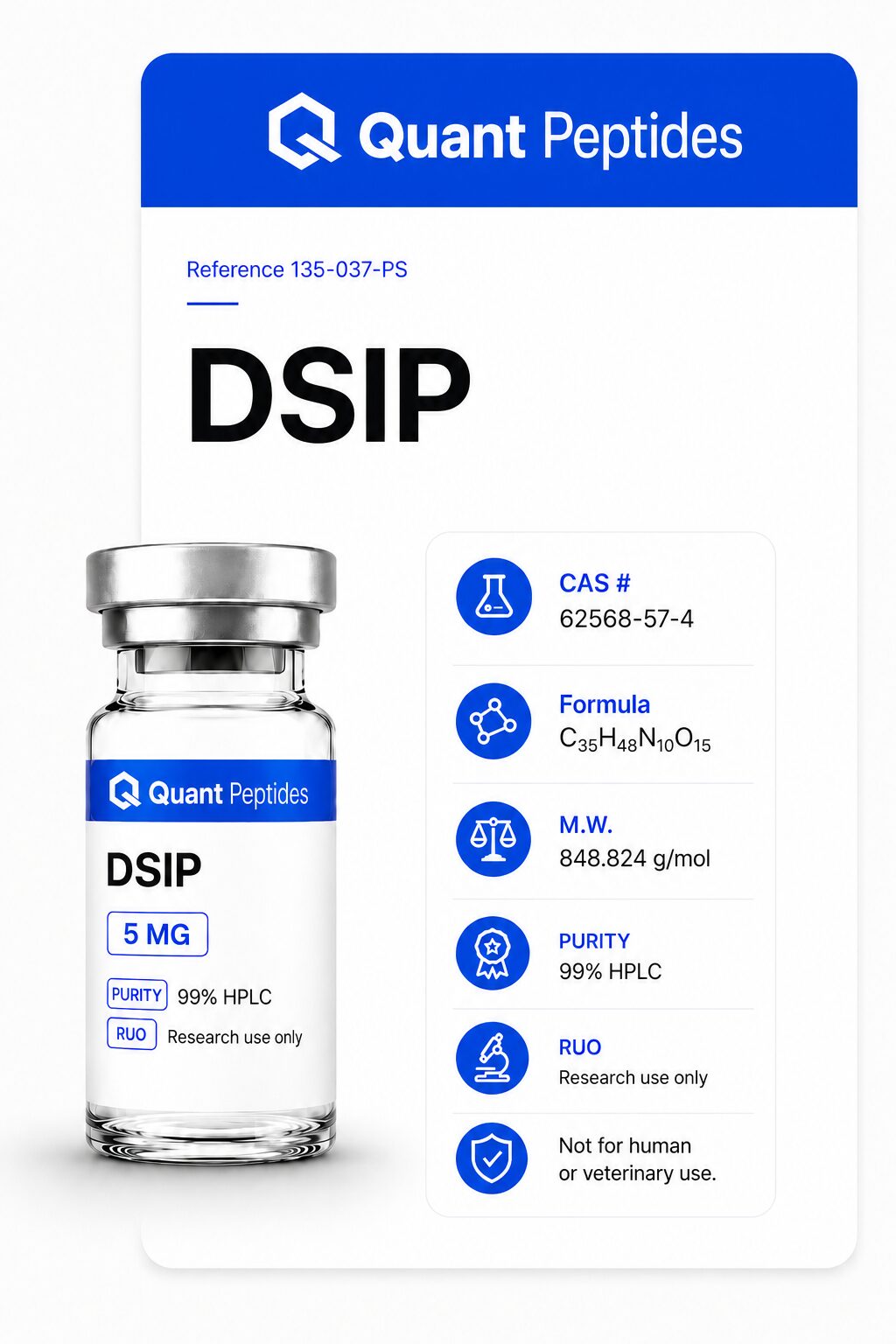
DSIP 5mg

Delta Sleep-Inducing Peptide, commonly known as DSIP, is a naturally occurring neuropeptide studied for its effects on the central nervous system, endocrine signaling, and several physiological processes.

Research has explored DSIP for its potential role in sleep regulation, oxidative stress reduction, mood-related pathways, and cardiovascular function. It has also been studied for its ability to help normalize myocardial contractility, which refers to the heart muscle’s ability to contract effectively.

Because of its influence on neurological and endocrine activity, DSIP remains an area of interest in research related to sleep, stress response, major depressive disorder, and overall nervous system regulation.

$95.00

Buy 3 and save 4%
$91.20 each
Buy 5 and save 6%
$89.30 each
Buy 10 and save 10%
$85.50 each

What Is DSIP? A Research Overview

Delta Sleep-Inducing Peptide, commonly known as DSIP, is a short naturally occurring peptide first isolated in 1977 from the brains of rats during slow-wave sleep. It received its name from early research showing its ability to promote sleep in rabbits.

Although DSIP was originally studied for its connection to sleep regulation, later research suggests that it may influence a wide range of physiological and endocrine processes. Studies have explored DSIP for its potential effects on corticotropin levels, somatostatin secretion, stress response, blood pressure regulation, sleep patterns, and pain perception.

DSIP has also become an area of interest in research related to oxidative stress, depression, cancer biology, and nervous system regulation. While its full mechanisms are still being investigated, DSIP remains a notable peptide in studies focused on sleep, stress adaptation, endocrine signaling, and neurophysiological balance.

DSIP Structure

Sequence: Trp-Ala-Gly-Gly-Asp-Ala-Ser-Gly-Glu
Molecular Formula: C35H48N10O15
Molecular Weight: 848.824 g/mol
PubChem CID: 68816
CAS Number: 62568-57-4
Synonyms: Emideltide, DSIP nonapeptide, Deltaran

DSIP Research

How DSIP May Influence Sleep Regulation

Despite its name, the relationship between Delta Sleep-Inducing Peptide, or DSIP, and sleep has been difficult to define clearly. After its initial discovery in rabbit studies, DSIP was studied extensively to better understand its effects on sleep architecture and sleep regulation. However, results have been mixed.

Some studies suggest that DSIP may promote slow-wave sleep and reduce paradoxical sleep, while others have found little to no measurable effect on sleep. In one study, DSIP appeared to increase arousal during the first hour of sleep, followed by a more sedative effect beginning in the second hour. Overall, this research suggests that DSIP may not act as a simple sedative, but may instead help regulate or normalize disrupted sleep patterns. [1]

Some of the strongest research involving DSIP has focused on chronic insomnia. In these studies, DSIP appeared to improve sleep quality enough that participants’ sleep patterns became closer to those observed in normal controls. Other studies have reported improvements in sleep structure, reduced sleep latency, and increased sleep efficiency in individuals with chronic insomnia. However, while these polysomnographic findings were statistically significant, the overall effect size was relatively modest. [2] [3]

Human research has also reported subjective improvements in sleep-related outcomes. DSIP has been associated with increased feelings of sleepiness, shorter time to sleep onset, and increased total sleep time compared with placebo. One study reported a 59% increase in sleep time compared to placebo. [4]

Interestingly, these subjective findings have not always matched EEG results, which often fail to show clear signs of sedation. This may be because many current EEG markers are designed to measure drug-induced sedation rather than natural sleep regulation. DSIP may therefore offer researchers a useful tool for reexamining how sleep is measured and understood in laboratory settings.

Overall, DSIP remains an important area of interest in sleep research, particularly for its potential role in sleep onset, insomnia, sleep-cycle regulation, and the broader biology of natural sleep.

How DSIP May Support Chronic Pain Research

Managing chronic pain can be challenging because many commonly used pain medications are better suited for short-term relief. Options such as NSAIDs and opioids may be effective, but long-term use can be associated with serious side effects, dependency concerns, tolerance, and rebound pain after discontinuation.

Research has explored Delta Sleep-Inducing Peptide, or DSIP, as a potential alternative pathway in chronic pain models. In a small preclinical human study, DSIP was associated with reduced pain perception and improved mood. The same study also suggested that DSIP may be useful in research involving physiological dependence on pain medications, as it appeared to help reduce withdrawal symptoms and the rebound pain that can occur after stopping long-term analgesic therapy. [5]

Animal research suggests that DSIP may produce some of its pain-modulating effects through activity at central opioid receptors. It is not yet clear whether this effect is direct or indirect, but studies in rats found that DSIP produced dose-dependent analgesic effects. [6]

Importantly, although DSIP appears to interact with pain-related opioid pathways, current research has not shown the same dependency profile associated with traditional opioid medications. This makes DSIP an area of interest in studies focused on chronic pain, withdrawal-related pain, mood changes, and non-opioid pain-regulation mechanisms.

How DSIP May Influence Metabolic Regulation

Research in rats suggests that Delta Sleep-Inducing Peptide, or DSIP, may help regulate stress-related metabolic changes that affect mitochondrial function. Under conditions of stress or low oxygen availability, mitochondria may shift away from oxygen-dependent energy production toward less efficient oxygen-independent pathways. This shift can increase the production of harmful metabolic byproducts and contribute to cellular stress. [7]

DSIP has been studied for its potential ability to help preserve oxidative phosphorylation, the process mitochondria use to produce energy efficiently with oxygen. By supporting mitochondrial function during periods of hypoxia, DSIP may help protect tissues from metabolic damage caused by reduced oxygen supply. This has made DSIP an area of interest in research related to stroke, heart attack, and other conditions involving temporary oxygen deprivation. [7]

These mitochondrial effects may also contribute to DSIP’s antioxidant-related properties. Instead of simply neutralizing free radicals after they form, DSIP may help reduce free-radical production at the source by supporting healthier mitochondrial energy metabolism. Because mitochondrial dysfunction and oxidative stress are closely linked to aging, DSIP remains an area of interest in anti-aging, metabolic health, and cellular-protection research.

DSIP May Influence Depression and Neurochemical Balance

The finding that Delta Sleep-Inducing Peptide, or DSIP, may help regulate mitochondrial activity during low-oxygen stress led researchers to examine the mechanisms behind this effect. Studies suggest that DSIP may help limit changes in monoamine oxidase type A, also known as MAO-A, as well as serotonin levels. Because both MAO-A and serotonin are closely connected to mood regulation, these findings raised interest in DSIP’s potential role in depression-related research. [8]

Analysis of cerebrospinal fluid from individuals with major depression has shown lower DSIP levels compared with control subjects. Since sleep disruption and depression are strongly linked, it is not surprising that a peptide involved in sleep-cycle regulation may also be connected to mood-related pathways. [9]

To date, research has not yet established DSIP as a treatment for depression through normalization of DSIP levels. However, DSIP has been associated with changes in the hypothalamic-pituitary-adrenal axis, or HPA axis, which plays a major role in stress response, cortisol regulation, and mood balance. DSIP has also been investigated for its possible relationship to suicidal behavior, making it an area of interest in neurochemical, stress-response, and depression-related research. [10] [11]

DSIP May Support Withdrawal and Addiction Research

Research has explored Delta Sleep-Inducing Peptide, or DSIP, for its potential role in reducing withdrawal symptoms during alcohol and opioid detoxification. In clinical studies, DSIP was associated with meaningful improvements in withdrawal-related symptoms, suggesting it may influence pathways involved in stress response, pain perception, mood regulation, and nervous system stabilization. [12]

In one study involving 107 patients experiencing alcohol or opioid withdrawal symptoms, 97% of alcohol-withdrawal patients and 87% of opioid-withdrawal patients showed either complete resolution of symptoms or significant improvement. Interestingly, opioid withdrawal appeared to be more resistant to treatment, requiring more DSIP injections over a longer period compared with alcohol withdrawal. [13]

Because withdrawal, especially alcohol withdrawal, can become medically serious and potentially life-threatening, any compound that may help reduce withdrawal severity is an important area of research. These findings make DSIP a continued point of interest in studies related to addiction, dependence, detoxification, stress regulation, and withdrawal-related nervous system changes.

DSIP May Support Cancer Prevention Research

Much of cancer research focuses on treating disease after diagnosis, but a growing area of investigation is centered on prevention — specifically, identifying ways to reduce the likelihood of cancer developing in the first place. Many prevention-focused strategies examine immune system activation, including cancer-vaccine approaches designed to help the body recognize and eliminate abnormal cells before they progress.

Research in mice suggests that Delta Sleep-Inducing Peptide, or DSIP, may have potential cancer-preventive effects in certain models. In one study, female mice received DSIP for five consecutive days each month, beginning at 3 months of age and continuing throughout their lifespan. Treated mice showed a 2.6-fold reduction in tumor development compared with controls. [14]

This decrease in tumor occurrence was also associated with a 22.6% reduction in chromosomal defects within bone marrow. Because chromosomal instability is closely linked to cancer development, these findings suggest that DSIP may support cellular protection, genomic stability, and cancer-prevention pathways in research models. [14]

While more research is needed to understand the exact mechanisms, DSIP remains an area of interest in studies involving oxidative stress, DNA protection, immune regulation, and long-term cancer risk reduction.

How DSIP May Support Cancer Adjuvant Research

One potential side effect of chemotherapy is disruption of central nervous system function. These changes may include impaired motor control, mood-related alterations such as depression, and difficulties with language or cognitive processing. Children undergoing chemotherapy may be especially vulnerable to these neurological effects, making protective strategies an important area of research.

Recent research suggests that Delta Sleep-Inducing Peptide, or DSIP, may help reduce or prevent some chemotherapy-associated changes in central nervous system function. This has led scientists to explore DSIP as a possible supportive compound in cancer adjuvant research. [15]

Part of this potential benefit may be related to DSIP’s effect on blood supply to the brain. Animal studies suggest that DSIP, as well as an alternative preparation known as Deltaran, may significantly improve cerebral blood flow during central nervous system stress, including ischemia and chemotherapy-related stress. [16]

In one animal model of cerebral ischemia, subjects treated with Deltaran had a 100% survival rate, compared with 62% survival in the control group. By supporting blood flow to the brain, DSIP may help reduce metabolic damage, improve tissue resilience, and promote recovery during neurological stress. [16]

These findings make DSIP an area of interest in research focused on chemotherapy-related neurological side effects, cerebral blood flow, brain protection, and supportive cancer-care pathways.

DSIP May Support Muscle Growth and Physiological Function

DSIP was first identified in the brains of rabbits during slow-wave sleep and has since been studied for its relationship to sleep and central nervous system regulation of sleep-wake cycles. However, researchers still do not fully understand where or how DSIP is synthesized. Interestingly, DSIP has been detected in peripheral tissues at levels similar to those found in the central nervous system, suggesting that its biological role may extend well beyond sleep regulation.

Some researchers have proposed that DSIP may act more like a hypothalamic regulatory peptide, influencing multiple physiological systems rather than one single function. This is similar to how growth hormone affects not only bone and muscle growth, but also metabolism, tissue repair, and broader endocrine signaling.

In one study, DSIP was found to inhibit somatostatin, a protein that can limit growth-related activity in muscle tissue. By reducing somatostatin activity, DSIP may support pathways involved in skeletal muscle hypertrophy and hyperplasia, meaning increased muscle cell size and potentially increased muscle cell number. [17]

These findings are especially interesting because DSIP was originally viewed mainly as a sleep-related peptide. Its effects on somatostatin and muscle-related signaling suggest that DSIP may have a broader role in regulating human physiology than researchers first believed.

Additional animal research has linked DSIP to regulation of blood pressure, heart rate, thermogenesis, and lymphokine system activity. Some of these effects appear before measurable signs of sleep, suggesting that DSIP may help shift the body into a physiological state that prepares for sleep rather than simply causing sleep directly. [18]

DSIP has demonstrated minimal side effects in mouse studies, along with low oral bioavailability and strong subcutaneous bioavailability. However, dosing data from animal studies does not directly translate to humans.

DSIP sold by Quant Peptides is intended strictly for educational and scientific research purposes only. It is not for human consumption and should only be purchased by licensed researchers.


Article Author

The above literature was researched, edited and organized by Dr. Logan, M.D. Dr. Logan holds a doctorate degree from Case Western Reserve University School of Medicine and a B.S. in molecular biology.

Scientific Journal Author

Shlomo Yehuda, Ph.D. has released hundreds of publications relating to the depths of neuroscience, thermoregulation, pharmacology, and the intricacies of colliding mechanisms of action. He specifically studied the effects of mice that consumed DSIP/DSIP-P while being continuously exposed to light, DSIP as a tool for investing the sleep onset mechanism, the peculiar thermoregulatory effects of DSIP at low and high doses, and the effects of DSIP on pain thresholds during light and dark periods in rats.

Shlomo Yehuda, Ph.D. is being referenced as one of the leading scientists involved in the research and development of DSIP. In no way is this doctor/scientist endorsing or advocating the purchase, sale, or use of this product for any reason. There is no affiliation or relationship, implied or otherwise, between Quant Peptides and this doctor. The purpose of citing the doctor is to acknowledge, recognize, and credit the exhaustive research and development efforts conducted by the scientists studying this peptide. Shlomo Yehuda, Ph.D. is listed in [19] [20] [21] and [22] under the referenced citations.

Referenced Citations

1

“The influence of synthetic DSIP (delta-sleep-inducing-peptide) on disturbed human sleep | SpringerLink.” [Online]. Available: https://link.springer.com/article/10.1007%2FBF01971753 . [Accessed: 25-Jun-2019].

2

“Effects of delta-sleep-inducing peptide on 24-hour sleep-wake behaviour in severe chronic insomnia. – PubMed – NCBI.” [Online]. Available: https://www.ncbi.nlm.nih.gov/pubmed/3622582. [Accessed: 25-Jun-2019].

3

“Effects of delta sleep-inducing peptide on sleep of chronic insomniac patients. A double-blind study. – PubMed – NCBI.” [Online]. Available: https://www.ncbi.nlm.nih.gov/pubmed/1299794. [Accessed: 25-Jun-2019].

4

“Acute and delayed effects of DSIP (delta sleep-inducing peptide) on human sleep behavior. – PubMed – NCBI.” [Online]. Available: https://www.ncbi.nlm.nih.gov/pubmed/6895513. [Accessed: 25-Jun-2019].

5

“Therapeutic effects of delta-sleep-inducing peptide (DSIP) in patients with chronic, pronounced pain episodes. A clinical pilot study. – PubMed – NCBI.” [Online]. Available: https://www.ncbi.nlm.nih.gov/pubmed/6548970. [Accessed: 25-Jun-2019].

6

“Potent antinociceptive effect of centrally administered delta-sleep-inducing peptide (DSIP). – PubMed – NCBI.” [Online]. Available: https://www.ncbi.nlm.nih.gov/pubmed/2853064. [Accessed: 25-Jun-2019].

7

“Delta sleep inducing peptide (DSIP): effect on respiration activity in rat brain mitochondria and stress protective potency under experimental hypo… – PubMed – NCBI.” [Online]. Available: https://www.ncbi.nlm.nih.gov/pubmed/12668217. [Accessed: 25-Jun-2019].

8

“Effects of delta-sleep inducing peptide (DSIP) and some analogues on the activity of monoamine oxidase type A in rat brain under hypoxia stress. – PubMed – NCBI.” [Online]. Available: https://www.ncbi.nlm.nih.gov/pubmed/7628639. [Accessed: 25-Jun-2019].

9

“Decreased concentrations of delta-sleep inducing peptide in plasma and cerebrospinal fluid from depressed patients: Nordisk Psykiatrisk Tidsskrift: Vol 39, No sup11.” [Online]. Available: https://www.tandfonline.com/doi/abs/10.3109/08039488509101959. [Accessed: 25-Jun-2019].

10

“Delta sleep-inducing peptide (DSIP): An overview of central actions and possible relationship to psychiatric illnesses: Nordisk Psykiatrisk Tidsskrift: Vol 42, No 2.” [Online]. Available: https://www.tandfonline.com/doi/abs/10.3109/08039488809103215. [Accessed: 25-Jun-2019].

11

“High delta sleep-inducing peptide-like immunoreactivity in plasma in suicidal patients with major depressive disorder. – PubMed – NCBI.” [Online]. Available: https://www.ncbi.nlm.nih.gov/pubmed/9606527. [Accessed: 25-Jun-2019].

12

“Opioid detoxification with delta sleep-inducing peptide: results of an open clinical trial. – PubMed – NCBI.” [Online]. Available: https://www.ncbi.nlm.nih.gov/pubmed/9617990. [Accessed: 25-Jun-2019].

13

“DSIP in the treatment of withdrawal syndromes from alcohol and opiates. – PubMed – NCBI.” [Online]. Available: https://www.ncbi.nlm.nih.gov/pubmed/6548969. [Accessed: 25-Jun-2019].

14

“Effect of delta-sleep inducing peptide-containing preparation Deltaran on biomarkers of aging, life span and spontaneous tumor incidence in female … – PubMed – NCBI.” [Online]. Available: https://www.ncbi.nlm.nih.gov/pubmed/12782416. [Accessed: 25-Jun-2019].

15

A. B. Sinyukhin, G. P. Timoshinov, V. A. Kornilov, and P. D. Shabanov, “P.7.a.006 Delta sleep-inducing peptide analogue corrects the CNS functional state of children treated with antiblastomic therapy,” Eur. Neuropsychopharmacol., vol. 19, pp. S681–S682, Sep. 2009.

16

E. V. Koplik et al., “Delta sleep-inducing peptide and Deltaran: potential approaches to antistress protection,” Neurosci. Behav. Physiol., vol. 38, no. 9, pp. 953–957, Nov. 2008.

17

“[DSIP: the sleep peptide or an unknown hypothalamic hormone?]. – PubMed – NCBI.” [Online]. Available: https://www.ncbi.nlm.nih.gov/pubmed/7817664. [Accessed: 25-Jun-2019].

18

“DSIP–a tool for investigating the sleep onset mechanism: a review. – PubMed – NCBI.” [Online]. Available: https://www.ncbi.nlm.nih.gov/pubmed/3286557. [Accessed: 25-Jun-2019].

ALL ARTICLES AND PRODUCT INFORMATION PROVIDED ON THIS WEBSITE ARE FOR INFORMATIONAL AND EDUCATIONAL PURPOSES ONLY.

The products offered on this website are furnished for in-vitro studies only. In-vitro studies (Latin: in glass) are performed outside of the body. These products are not medicines or drugs and have not been approved by the FDA to prevent, treat or cure any medical condition, ailment or disease. Bodily introduction of any kind into humans or animals is strictly forbidden by law.

COA

HPLC

MS

Storage Instructions:

Storage & Stability

Our peptides are produced using a specialized freeze-drying process known as lyophilization. This process removes moisture from the peptide while preserving its structure, helping maintain stability during storage and shipping.

Before reconstitution, lyophilized peptides are typically presented as a dry, white powder or cake inside the vial. In this form, they are generally more stable than liquid peptides and can better tolerate short-term temperature changes that may occur during transit.

Once received, peptides should be stored in a cool, dry place away from direct light. For short-term storage, refrigeration at approximately 4°C / 39°F is commonly recommended. For longer-term storage, keeping lyophilized peptides frozen may help preserve their stability over time.

After the peptide is reconstituted with bacteriostatic water, it should be stored in the refrigerator and protected from light. Reconstituted peptides are generally recommended for use within 30 days to help maintain quality and stability.

In simple terms:
Lyophilized peptides are designed to remain stable while dry, but once mixed, they should be kept cold and handled with care.