Product Usage: This PRODUCT IS INTENDED AS A RESEARCH CHEMICAL ONLY. This designation allows the use of research chemicals strictly for in vitro testing and laboratory experimentation only. All product information available on this website is for educational purposes only. Bodily introduction of any kind into humans or animals is strictly forbidden by law. This product should only be handled by licensed, qualified professionals. This product is not a drug, food, or cosmetic and may not be misbranded, misused or mislabeled as a drug, food or cosmetic.

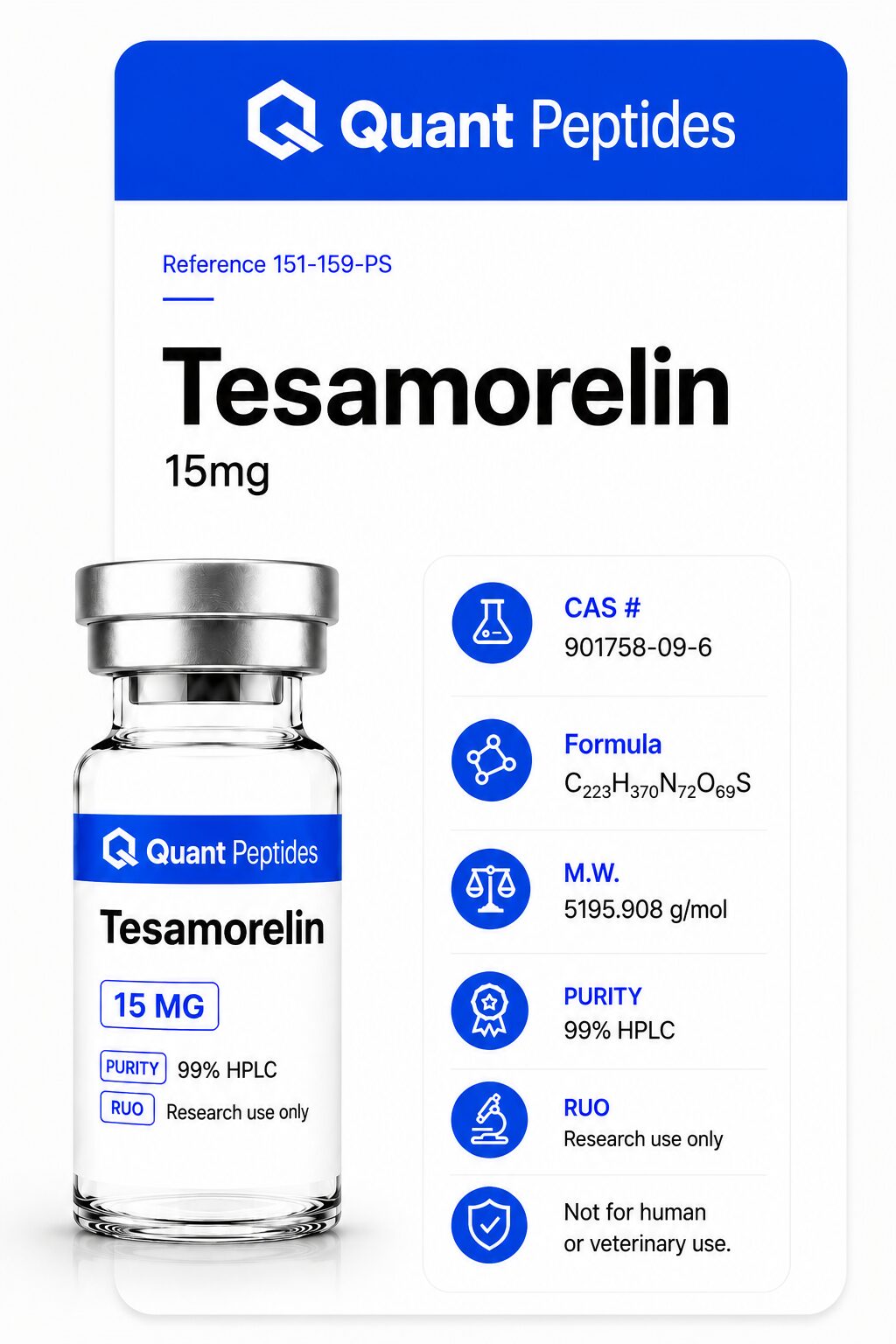
Tesamorelin 15mg

Tesamorelin is a 44-amino-acid synthetic peptide and GHRH analogue researched for its ability to stimulate growth hormone-related pathways. It has been studied extensively in HIV-associated lipodystrophy, a condition involving abnormal visceral fat accumulation and metabolic dysfunction.

Studies suggest that Tesamorelin may help reduce visceral adiposity, with research showing reductions of nearly 20% in this population. It has also been investigated for its potential role in peripheral nerve health, mild cognitive impairment, and broader metabolic research applications. [1]

$149.00

Buy 5 and save 5%
$141.55 each
Buy 10 and save 8%
$137.08 each

What is Tesamorelin?

Tesamorelin is a growth hormone-releasing hormone (GHRH) analogue made from standard GHRH with the addition of a trans-3-hexenoic acid group. In 2010, tesamorelin became the newest peptide approved by the FDA for use in HIV-associated lipodystrophy.

It has also been researched for its potential role in supporting peripheral nerve regeneration and as a possible intervention for mild cognitive impairment (MCI), a condition often considered a precursor to dementia.


Tesamorelin Structure

Tesamorelin Structure

Sequence (Single Letter): Unk-Tyr-Ala-Asp-Ala-Ile-Phe-Thr-Asn-Ser-Tyr-Arg-Lys-Val-Leu-Gly-Gln-Leu-Ser-Ala-Arg-Lys-Leu-Leu-Gln-Asp-Ile-Met-Ser-Arg-Gln-Gln-Gly-Glu-Ser-Asn-Gln-Glu-Arg-Gly-Ala-Arg-Ala-Arg-Leu

Molecular Formula: C₂₂₃H₃₇₀N₇₂O₆₉S

Molecular Weight: 5195.908 g/mol

PubChem CID: 44147413

CAS Number: 901758-09-6

Tesamorelin Research

As a GHRH analogue, tesamorelin shares many of the same research characteristics as growth hormone-releasing hormone and related compounds such as sermorelin, GRF (1-29), and CJC-1295. The addition of a trans-3-hexenoic acid group helps improve tesamorelin’s stability in human plasma, which may contribute to an increased half-life.

Despite this enhanced stability, tesamorelin appears to preserve the natural physiological action of GHRH. This means it may support normal pulsatile growth hormone (GH) release rather than disrupting the body’s natural GH rhythm, which can occur with certain other compounds.

Tesamorelin and Lipodystrophy

Tesamorelin has been widely researched for its role in HIV-associated lipodystrophy, a condition involving abnormal fat accumulation that may occur as a result of HIV infection and/or antiretroviral therapy. In this condition, fat can accumulate excessively in the abdominal region and other areas of the body. While the exact mechanism is not fully understood, some research suggests that commonly used protease inhibitors may play a role in its development [1].

Before tesamorelin, treatment options for HIV-associated lipodystrophy were limited. Diet, exercise, and available medications were often insufficient, while surgery was typically considered a last-resort option and could be inconsistent or complicated. In 2010, tesamorelin was approved by the FDA for the treatment of HIV-associated lipodystrophy.

Research has shown that tesamorelin may reduce adiposity by nearly 20% in this population [1]. Additional studies suggest that tesamorelin may be significantly more effective at reducing adiposity than other available treatment approaches [2].

Tesamorelin Investigated in Cardiac Disease

Individuals living with HIV may have an increased risk of cardiovascular disease, partly due to abnormal fat distribution and partly due to the long-term effects of antiretroviral therapy. Because of this, cardiovascular risk management is an important area of research in HIV-positive populations.

Studies have explored tesamorelin not only for its effects on lipodystrophy, but also for its potential impact on cardiovascular-related markers. Research suggests that tesamorelin may help reduce triglycerides, total cholesterol, and non-HDL cholesterol levels in HIV-positive individuals. One study found that a 15% reduction in visceral adipose tissue with tesamorelin was associated with a 50 mg decrease in triglyceride levels [3,4].

Ectopic fat deposition, as seen in lipodystrophy, is associated with increased inflammation. Chronic inflammation is a known risk factor for cardiovascular disease. Visceral adipose tissue, liver fat, and epicardial fat are each independently linked to a higher risk of cardiovascular complications. By helping reduce ectopic fat accumulation, tesamorelin may support lower inflammation levels and contribute to improved cardiovascular risk factors.

Ectopic fat accumulation, commonly seen in lipodystrophy, is associated with increased inflammation. Since inflammation is a recognized contributor to cardiovascular risk, reducing excess visceral and organ-associated fat may support overall cardiometabolic health. Research suggests that tesamorelin may help reduce ectopic fat deposits, including visceral fat, which may contribute to improved inflammatory and cardiovascular risk markers.


References

1

Ann N Y Acad Sci. 2010 Apr;1194:87-96.  Thymosin beta4 and cardiac repair. Shrivastava S1, Srivastava D, Olson EN, DiMaio JM, Bock-Marquette I.

2

Nature. 2004 Nov 25;432(7016):466-72. Thymosin beta4 activates integrin-linked kinase and promotes cardiac cell migration, survival and cardiac repair.  Bock-Marquette I1, Saxena A, White MD, Dimaio JM, Srivastava D.

3

Chest. 2006 Nov;130(5):1433-40.  Thymosin beta4 sequesters actin in cystic fibrosis sputum and decreases sputum cohesivity in vitro. Rubin BK1, Kater AP, Goldstein AL.

4

J Biochem. 2011 Jan;149(1):43-8. doi: 10.1093/jb/mvq115. Epub 2010 Sep 29. Muscle injury-induced thymosin β4 acts as a chemoattractant for myoblasts. Tokura Y1, Nakayama Y, Fukada S, Nara N, Yamamoto H, Matsuda R, Hara T.

5

https://clinicaltrials.gov/show/NCT00598871

6

Ann N Y Acad Sci. 2010 Apr;1194:199-206. doi: 10.1111/j.1749-6632.2010.05471.x. Treatment of chronic nonhealing neurotrophic corneal epithelial defects with thymosin beta4.  Dunn SP1, Heidemann DG, Chow CY, Crockford D, Turjman N, Angel J, Allan CB, Sosne G.

7

Medicine (Baltimore).2016 Dec;95(52):e5763. doi: 10.1097/MD.0000000000005763. The expression of thymosin β4 in chronic hepatitis B combined nonalcoholic fatty liver disease.  Liang J1, Cai W, Han T, Jing L, Ma Z, Gao Y.

8

Ann N Y Acad Sci. 2010 Apr;1194:223-9. doi: 10.1111/j.1749-6632.2010.05474.x. A randomized, placebo-controlled, single and multiple dose study of intravenous thymosin beta4 in healthy volunteers.  Ruff D1, Crockford D, Girardi G, Zhang Y.

9

Lymphokine Res. 1989 Winter;8(4):383-91.  Modulation of thymosin alpha 1 and thymosin beta 4 levels and peripheral blood mononuclear cell subsets during experimental rhinovirus colds.  Hsia J1, Sztein MB, Naylor PH, Simon GL, Goldstein AL, Hayden FG.

10

Kidney Int. 2016 Nov;90(5):1056-1070. doi: 10.1016/j.kint.2016.06.032. Epub 2016 Aug 26.  Loss of endogenous thymosin β4 accelerates glomerular disease. Vasilopoulou E1, Kolatsi-Joannou M1, Lindenmeyer MT2, White KE3, Robson MG4, Cohen CD2, Sebire NJ1, Riley PR5, Winyard PJ1, Long DA6.

11

Vitam Horm. 2016;102:251-75. doi: 10.1016/bs.vh.2016.04.005. Epub 2016 May 24. Thymosin β4 Promotes Dermal Healing.  Kleinman HK1, Sosne G2.

12

Expert Opin Biol Ther. 2015;15 Suppl 1:S139-45.doi:10.1517/14712598.2015. 1011617.  Epub 2015 Jun 22. Advances in the basic and clinical applications of thymosin β4. Goldstein AL1, Kleinman HK.

13

J Orthop Res. 2014 Oct;32(10):1277-82. doi: 10.1002/jor.22686. Epub 2014 Jul 8. Thymosin β4 administration enhances fracture healing in mice. Brady RD1, Grills BL, Schuijers JA, Ward AR, Tonkin BA, Walsh NC, McDonald SJ.

14

Neuropharmacology. 2014 Oct;85:408-16. doi: 10.1016/j.neuropharm.2014.06.004. Epub 2014 Jun 14.  Beneficial effects of thymosin β4 on spinal cord injury in the rat. Cheng P1, Kuang F1, Zhang H1, Ju G2, Wang J3.

15

Ann N Y Acad Sci. 2012 Oct;1270:51-8. doi: 10.1111/j.1749-6632.2012.06683.x. Neuroprotective and neurorestorative effects of thymosin β4 treatment following experimental traumatic brain injury.  Xiong Y1, Mahmood A, Meng Y, Zhang Y, Zhang ZG, Morris DC, Chopp M.

16

Neurobiol Dis. 2016 Apr;88:85-95. doi: 10.1016/j.nbd.2016.01.010. Epub 2016 Jan 12.  Thymosin beta4 promotes oligodendrogenesis in the demyelinating central nervous system.  Zhang J1, Zhang ZG2, Li Y2, Lu M3, Zhang Y2, Elias SB2, Chopp M4.

ALL ARTICLES AND PRODUCT INFORMATION PROVIDED ON THIS WEBSITE ARE FOR INFORMATIONAL AND EDUCATIONAL PURPOSES ONLY.

The products offered on this website are furnished for in-vitro studies only. In-vitro studies (Latin: in glass) are performed outside of the body. These products are not medicines or drugs and have not been approved by the FDA to prevent, treat or cure any medical condition, ailment or disease. Bodily introduction of any kind into humans or animals is strictly forbidden by law.

Certificate of Analysis (COA)

High Performance Liquid Chromatography (HPLC)

Mass Spectrometry (MS)

COA

HPLC

MS

Storage Instructions:

Storage & Stability

Our peptides are produced using a specialized freeze-drying process known as lyophilization. This process removes moisture from the peptide while preserving its structure, helping maintain stability during storage and shipping.

Before reconstitution, lyophilized peptides are typically presented as a dry, white powder or cake inside the vial. In this form, they are generally more stable than liquid peptides and can better tolerate short-term temperature changes that may occur during transit.

Once received, peptides should be stored in a cool, dry place away from direct light. For short-term storage, refrigeration at approximately 4°C / 39°F is commonly recommended. For longer-term storage, keeping lyophilized peptides frozen may help preserve their stability over time.

After the peptide is reconstituted with bacteriostatic water, it should be stored in the refrigerator and protected from light. Reconstituted peptides are generally recommended for use within 30 days to help maintain quality and stability.

In simple terms:
Lyophilized peptides are designed to remain stable while dry, but once mixed, they should be kept cold and handled with care.