Access to this website is restricted to individuals who are at least 21 years of age. This site contains research-use product information intended for scientific and development purposes.
Please confirm your age to enter this website.
By continuing, you confirm that you meet the minimum age requirement.
Access your account & orders history.
Enter your username or email address. You will receive a link to create a new password via email.
A link to set a new password will be sent to your email address.
GHK-Cu is a naturally occurring copper-binding peptide found in human plasma, urine, and saliva. It has been studied for its potential role in wound healing, skin health, immune function, and tissue repair.
Animal research suggests that GHK-Cu may support wound-healing pathways by stimulating collagen production, activating fibroblasts, and promoting the formation of new blood vessels. These processes are important for tissue remodeling, repair, and overall skin regeneration.
Research also suggests that GHK-Cu may act as a biological feedback signal released after tissue injury, helping coordinate repair activity in damaged areas. In addition, GHK-Cu has been studied for its antioxidant properties, including its ability to help reduce free-radical damage and support cellular protection.
$99.00
GHK-Cu, also known as copper peptide GHK-Cu, is a naturally occurring peptide first isolated from human blood plasma and later identified in urine and saliva. It has been widely studied for its potential role in wound healing, skin health, tissue repair, and immune function.
Research suggests that GHK-Cu may support anti-aging and regenerative pathways by helping reduce free-radical damage, promote protein synthesis, support bacterial defense mechanisms, and improve the health and activity of skin fibroblasts. Because fibroblasts are essential for collagen production and tissue structure, GHK-Cu remains an area of interest in studies related to skin repair, wound recovery, and overall tissue regeneration.
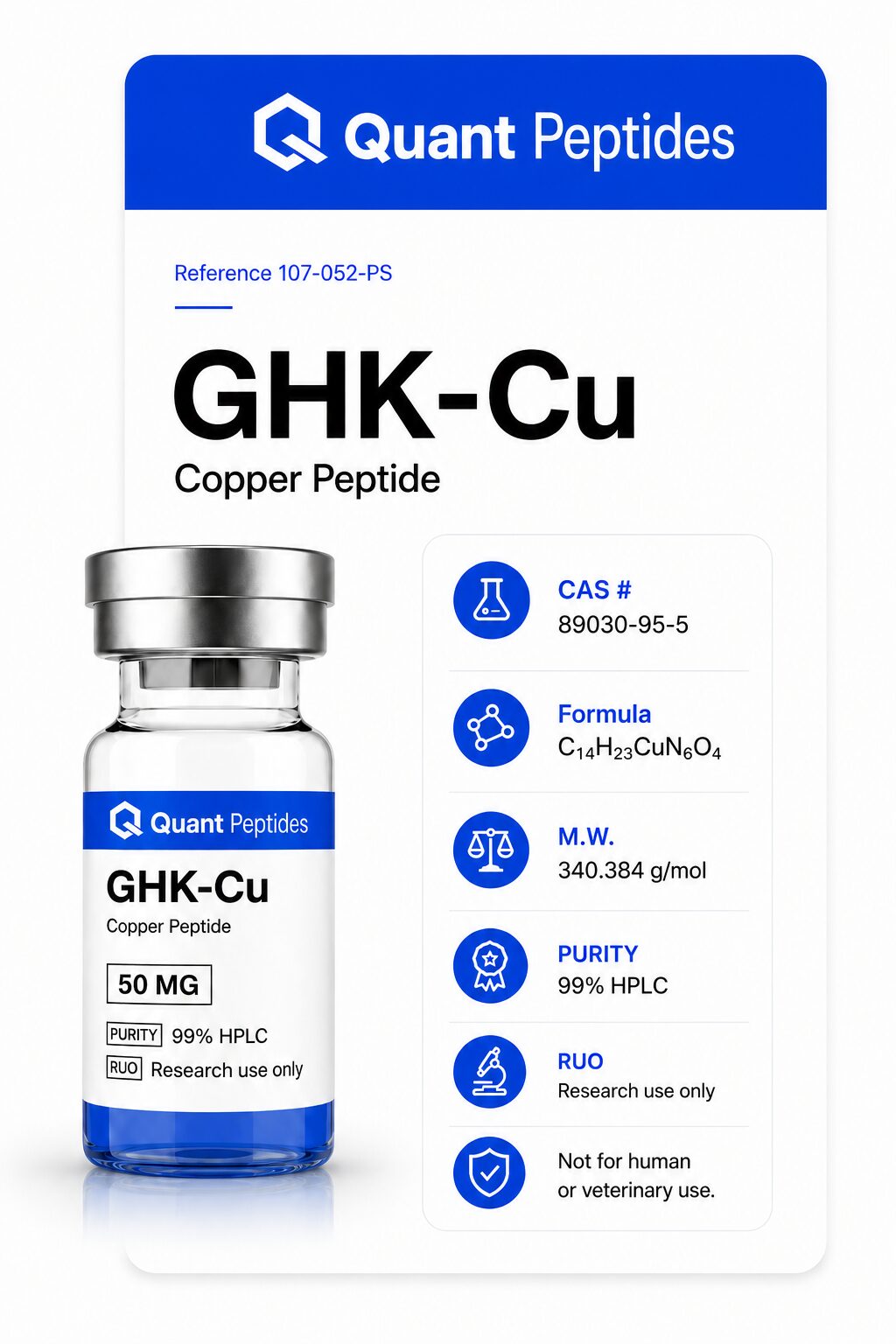
Sequence: Gly-His-Lys.Cu.xHAc
Molecular Formula: C14H23CuN6O4
Molecular Weight: 401.91 g/mol
PubChem CID: 73587
CAS Number: 89030-95-5
GHK-Cu is a naturally occurring copper-binding peptide found in human blood. Research suggests that it plays an important role in skin repair, tissue regeneration, and wound-healing pathways. In skin culture studies, GHK-Cu has been shown to influence the production and remodeling of collagen, glycosaminoglycans, proteoglycans, chondroitin sulfate, and other key components of the extracellular matrix. [1]
Part of this activity appears to come from GHK-Cu’s ability to recruit important repair-related cells, including fibroblasts, immune cells, and endothelial cells, to areas of tissue damage. These cells are essential for rebuilding skin structure, regulating inflammation, and supporting the formation of new blood vessels. In this way, GHK-Cu may help coordinate multiple stages of the wound-repair process. [1]
GHK-Cu is also commonly studied in cosmetic and skin-health research. It has been associated with improved skin elasticity, firmness, and overall texture. Research suggests it may help reduce the appearance of sun damage, hyperpigmentation, fine lines, and wrinkles. Its role in collagen regulation may also be important for scar appearance, rough skin texture, hypertrophic healing, and age-related changes in skin structure. [1]
Some of these effects may be connected to GHK-Cu’s influence on transforming growth factor beta, also known as TGF-β, a signaling molecule involved in collagen production, tissue repair, and cellular communication. Additional studies suggest that GHK-Cu may act through several biochemical pathways, including effects at the level of gene transcription. [2] [3]
In mouse research, GHK-Cu has been shown to increase burn-healing rates by as much as 33%. This effect may be due not only to its ability to recruit immune cells and fibroblasts, but also to its support of new blood vessel formation. Because burned tissue can be slow to revascularize due to cauterization-related damage, GHK-Cu remains an area of interest in burn recovery, wound care, and regenerative skin research. [4]
One of the major reasons wounds heal slowly, or fail to heal properly, is the invasion of damaged tissue by foreign pathogens. Bacterial and fungal infections can be especially challenging in burn wounds and in individuals with compromised immune function, including conditions such as diabetes or HIV.
Research suggests that GHK-Cu, when combined with certain fatty acids, may form a potent antimicrobial complex with activity against several bacteria and fungi known to interfere with wound healing. This has made GHK-Cu an area of interest in studies involving wound protection, infection control, and tissue repair. [5]
Clinical research in diabetic ulcers has also explored GHK-Cu alongside standard wound-care protocols. In these studies, patients receiving both standard care and GHK-Cu showed approximately a 40% improvement in wound closure and a 27% reduction in infection rates compared with control groups. Similar findings have been reported in research involving ischemic open wounds. [6] [7]
Together, these findings suggest that GHK-Cu may support wound-healing outcomes not only by promoting tissue repair, but also by helping reduce microbial complications that can delay recovery.
Neuronal decline associated with degenerative conditions such as Alzheimer’s disease remains complex and not fully understood. Because of this, developing effective therapies has been challenging, and many current approaches offer limited results. Research suggests that GHK-Cu may help counter certain age-related changes in nervous system function that are often associated with cognitive decline and neurodegenerative processes.
Studies indicate that GHK-Cu may support angiogenesis within the nervous system, promote nerve outgrowth, and help regulate inflammation in the central nervous system. Research has also explored its potential ability to influence gene expression patterns, including the possibility of helping shift dysfunctional or age-related gene activity toward a healthier biological state. [8]
GHK-Cu is naturally present in the brain at relatively high concentrations, but its levels appear to decline with age. Some researchers have proposed that GHK-Cu may help protect nervous system tissue from age-related stressors such as inflammation, impaired repair signaling, and gene dysregulation.
This has led to the theory that declining GHK-Cu levels may contribute to the loss of normal neurological maintenance over time. Rather than neurodegeneration being driven only by new disease processes, researchers are also investigating whether reduced protective peptides like GHK-Cu may weaken the brain’s ability to repair, regulate, and maintain healthy function as we age.
Research in rat models suggests that one way GHK-Cu may help protect brain tissue is by reducing apoptosis, or programmed cell death. This effect appears to involve the miR-339-5p/VEGFA pathway, a signaling pathway that becomes active after neurological injuries such as brain bleeds and stroke. [9]
In these models, GHK-Cu was associated with improved neurological outcomes, reduced brain swelling, and lower levels of neuron death. Researchers found that GHK-Cu may help counter the harmful effects linked to overexpression of miR-339-5p, which can contribute to neuronal damage after injury. [9]
These findings suggest that GHK-Cu may support nervous system repair by helping regulate inflammation, vascular signaling, and cell-survival pathways following brain injury.
Research in mouse models suggests that GHK-Cu may help protect lung tissue from fibrosis associated with treatment using bleomycin, a chemotherapy medication known to cause lung-related side effects in certain settings. These findings have led researchers to explore whether GHK-Cu may have potential as a supportive compound in chemotherapy-related tissue protection research. [10]
In this study, researchers also investigated the possible mechanisms behind GHK-Cu’s protective effects. The peptide appeared to help regulate inflammatory markers, including TNF-alpha and IL-6, both of which are involved in inflammation, extracellular matrix remodeling, and smooth muscle activity within the lungs. By helping reduce inflammatory signaling, GHK-Cu may support healthier collagen organization and limit fibrotic remodeling in lung tissue. [10]
Similar protective effects have also been observed in mouse models of acute respiratory distress syndrome, or ARDS, a serious inflammatory lung condition that can develop rapidly and may be associated with injury, infection, or certain medications, including chemotherapy-related drugs. In these models, GHK-Cu again appeared to mediate its effects through reduced TNF-alpha and IL-6 expression. [11]
Together, these findings suggest that GHK-Cu may be an important area of research for chemotherapy-associated tissue stress, lung inflammation, fibrosis pathways, and recovery-focused supportive care models.
In rat models, GHK-Cu administration has been shown to produce a dose-dependent reduction in pain-related behavior. Research suggests that these analgesic-like effects may be linked to increased levels of L-lysine, a naturally occurring amino acid involved in pain-modulating pathways. [12]
Additional research has found that GHK-Cu may also increase levels of L-arginine, another amino acid studied for its role in pain regulation, circulation, and tissue repair. These findings have made GHK-Cu an area of interest in non-opioid pain research, particularly for exploring pain-control mechanisms that do not rely on addictive opioid medications or long-term NSAID use. [13]
Because GHK-Cu also influences inflammation, tissue repair, and cellular recovery pathways, researchers continue to investigate how it may affect pain signaling in injury, inflammation, and regenerative models.
GHK-Cu has demonstrated minimal side effects in mouse studies, along with low oral bioavailability and strong subcutaneous bioavailability. However, dosing data from animal studies does not directly translate to humans.
GHK-Cu sold by Quant Peptides is intended strictly for educational and scientific research purposes only. It is not for human consumption and should only be purchased by licensed researchers.
The above literature was researched, edited and organized by Dr. Logan, M.D. Dr. Logan holds a doctorate degree from Case Western Reserve University School of Medicine and a B.S. in molecular biology.
Loren Pickart, Ph.D. has released 109 publications and is developing patents and analyzing GHK’s effects on human gene expression of 4,192 genes. In addition to GHK’s published potential uses on skin inflammation, metastatic cancer and COPD, it appears to have beneficial effects on other tissue systems such as the nervous system, gastrointestinal system, and mitochondrial system. His brief but detailed autobiography dives into the motivations and background behind his dedicating to skin, anti-aging, and life-long training.
Loren Pickart, Ph.D is being referenced as one of the leading scientists involved in the research and development of GHK-Cu. In no way is this doctor/scientist endorsing or advocating the purchase, sale, or use of this product for any reason. There is no affiliation or relationship, implied or otherwise, between Quant Peptides and this doctor. The purpose of citing the doctor is to acknowledge, recognize, and credit the exhaustive research and development efforts conducted by the scientists studying this peptide. Loren Pickart, Ph.D is listed in [1] [3] and [8] under the referenced citations.
A. Gruchlik, E. Chodurek, and Z. Dzierzewicz, “Effect of GLY-HIS-LYS and its copper complex on TGF-β secretion in normal human dermal fibroblasts,” Acta Pol. Pharm., vol. 71, no. 6, pp. 954–958, Dec. 2014. [PubMed]
L. Pickart and A. Margolina, “Regenerative and Protective Actions of the GHK-Cu Peptide in the Light of the New Gene Data,” Int. J. Mol. Sci., vol. 19, no. 7, Jul. 2018. [PubMed]
X. Wang et al., “GHK-Cu-liposomes accelerate scald wound healing in mice by promoting cell proliferation and angiogenesis,” Wound Repair Regen. Off. Publ. Wound Heal. Soc. Eur. Tissue Repair Soc., vol. 25, no. 2, pp. 270–278, 2017. [PubMed]
M. Kukowska, M. Kukowska-Kaszuba, and K. Dzierzbicka, “In vitro studies of antimicrobial activity of Gly-His-Lys conjugates as potential and promising candidates for therapeutics in skin and tissue infections,” Bioorg. Med. Chem. Lett., vol. 25, no. 3, pp. 542–546, Feb. 2015. [Science Direct]
G. D. Mulder et al., “Enhanced healing of ulcers in patients with diabetes by topical treatment with glycyl-l-histidyl-l-lysine copper,” Wound Repair Regen. Off. Publ. Wound Heal. Soc. Eur. Tissue Repair Soc., vol. 2, no. 4, pp. 259–269, Oct. 1994. [PubMed]
L. Pickart, J. M. Vasquez-Soltero, and A. Margolina, “The Effect of the Human Peptide GHK on Gene Expression Relevant to Nervous System Function and Cognitive Decline,” Brain Sci., vol. 7, no. 2, Feb. 2017. [PubMed]
H. Zhang, Y. Wang, and Z. He, “Glycine-Histidine-Lysine (GHK) Alleviates Neuronal Apoptosis Due to Intracerebral Hemorrhage via the miR-339-5p/VEGFA Pathway,” Front. Neurosci., vol. 12, p. 644, 2018. [PubMed]
X.-M. Zhou et al., “GHK Peptide Inhibits Bleomycin-Induced Pulmonary Fibrosis in Mice by Suppressing TGFβ1/Smad-Mediated Epithelial-to-Mesenchymal Transition,” Front. Pharmacol., vol. 8, p. 904, 2017. [PubMed]
J.-R. Park, H. Lee, S.-I. Kim, and S.-R. Yang, “The tri-peptide GHK-Cu complex ameliorates lipopolysaccharide-induced acute lung injury in mice,” Oncotarget, vol. 7, no. 36, pp. 58405–58417, Sep. 2016. [PubMed]
L. А. Sever’yanova and M. E. Dolgintsev, “Effects of Tripeptide Gly-His-Lys in Pain-Induced Aggressive-Defensive Behavior in Rats,” Bull. Exp. Biol. Med., vol. 164, no. 2, pp. 140–143, Dec. 2017. [Springer]
L. А. Sever’yanova and D. V. Plotnikov, “Binding of Glyprolines to L-Arginine Inverts Its Analgesic and Antiagressogenic Effects,” Bull. Exp. Biol. Med., vol. 165, no. 5, pp. 621–624, Sep. 2018. [PubMed]
Storage & Stability
Our peptides are produced using a specialized freeze-drying process known as lyophilization. This process removes moisture from the peptide while preserving its structure, helping maintain stability during storage and shipping.
Before reconstitution, lyophilized peptides are typically presented as a dry, white powder or cake inside the vial. In this form, they are generally more stable than liquid peptides and can better tolerate short-term temperature changes that may occur during transit.
Once received, peptides should be stored in a cool, dry place away from direct light. For short-term storage, refrigeration at approximately 4°C / 39°F is commonly recommended. For longer-term storage, keeping lyophilized peptides frozen may help preserve their stability over time.
After the peptide is reconstituted with bacteriostatic water, it should be stored in the refrigerator and protected from light. Reconstituted peptides are generally recommended for use within 30 days to help maintain quality and stability.
In simple terms:
Lyophilized peptides are designed to remain stable while dry, but once mixed, they should be kept cold and handled with care.